Skip to content
IOP Science

Co-review with a colleague

What is co-review?

Co-review enables two people to collaborate on a reviewer report, with both having the option to receive recognition via Web of Science. Co-review aims to help early career researchers with limited peer review experience build their skills alongside more experienced colleagues or supervisors.

Critiquing manuscripts can deepen early career researchers’ subject knowledge, improve their understanding of how to structure and write papers, and boost confidence in their expertise.


How to co-review on IOP Publishing journals
All reviewers must follow the reviewer guidelines for IOP Publishing journals, including ethics for reviewers and COPE’s Ethical Guidelines for Peer Reviewers.


Co-review FAQs


  • I want to co-review with a junior colleague—what should I do?

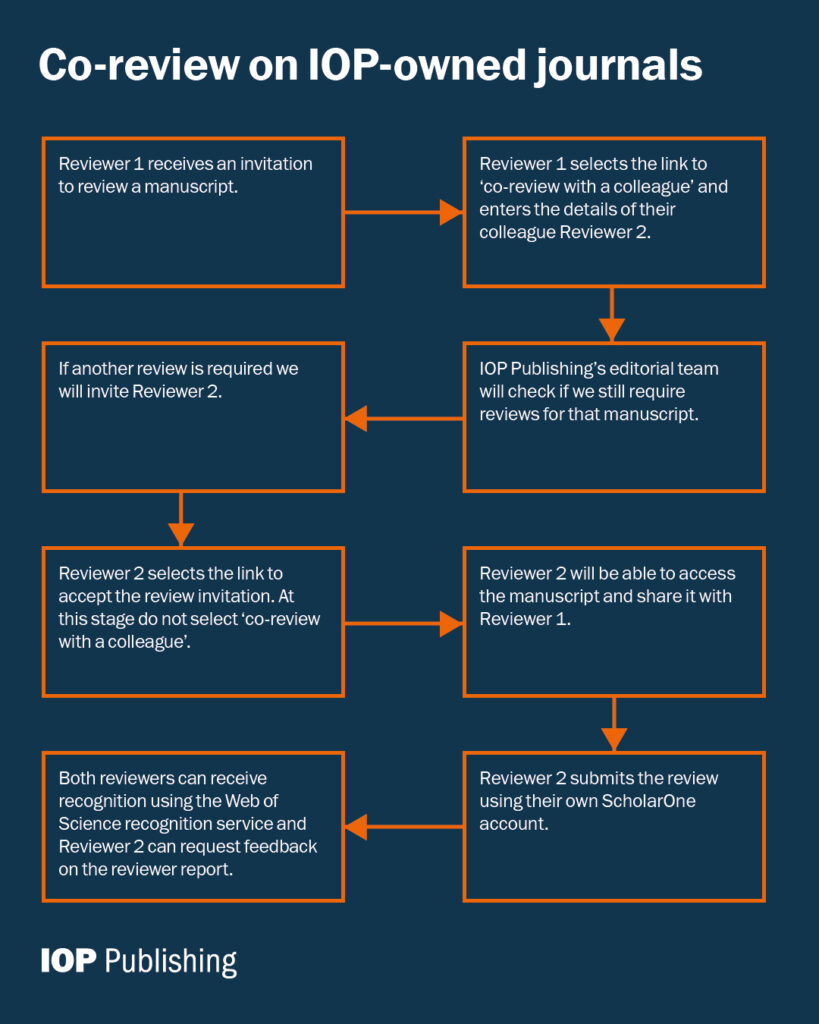
If you’re invited to review and want to co-review with a colleague, select the “Co-review with a colleague” link in the invitation email, then enter their name and contact details in the box provided. IOP Publishing handles all data in line with our privacy policy.

If reviewers are still needed, your colleague will be invited to review. If they accept, they will need to share the manuscript PDF with you so you can work on the report together offline. The final report should be submitted via your co-reviewer’s ScholarOne account.

Senior researchers are encouraged to support junior colleagues through the process by:

    • Making sure expectations are clear
    • Setting a timeline to allow them to complete the report but also meet the deadline
    • Reviewing and discussing the report before submission
    • Checking the recommendation aligns with the report content


  • I have been invited to co-review by a senior colleague—what should I do?

If you’re invited to co-review with a colleague, do not select the “Co-review with a colleague” link in the invitation email—please select “Agree” instead.

Once you receive the “Paper now ready to review…” email, you can share the manuscript PDF with your colleague and work on the report together offline.

Although you are responsible for writing and submitting the reviewer report, the colleague who recommended you should support you through the process. When the report is complete and both of you are satisfied, you should submit it to the journal through your ScholarOne account.


  • Is there any additional training or guidance for new reviewers?

Yes—IOP Publishing offers free, online peer review training, tailored specifically for the physical sciences. The training course takes approximately 2 hours to complete and can be accessed here: Peer Review Excellence.

For more information on how to submit a report, you can read our guidance on How to prepare and send in your reviewer report.


  • Can journal board members use the co-review functionality?

Board members should not request to co-review with a colleague, as we rely on your expertise in your field and your knowledge of the journal. Also, there may be problems with confidentiality, so it is inappropriate for your colleague to work on the report.


  • I requested to co-review with a colleague, but they have not been invited yet?

There may be a short delay between you requesting to co-review with a colleague and your colleague being invited. Our editorial team will need to check if more reviewer reports are needed on the manuscript. In some cases, other reviewers will have accepted their review invitations and additional reports are not required.


  • Can I delegate a review to more than one colleague?

If you would like more than one colleague to work on the reviewer report, please contact the journal inbox. We do allow this for a maximum of 3 people, but it is important that our editorial team know who has written the report. Only one colleague will be able to receive the invitation and submit the reviewer report via ScholarOne.


  • Will all co-reviewers receive an evaluation of the report?

No, only the person who submitted the report will receive an evaluation, provided they opt in on the report form. However, all co-reviewers can gain recognition through the Web of Science Reviewer Recognition Service.


Why do we offer co-review on our journals?

At IOP Publishing, we are aware that early career researchers and PhD students will occasionally write reviewer reports on behalf of their supervisors without receiving any credit for their work. Some of the benefits of co-review include:

    • Alleviating the burden for senior researchers who receive many invitations to review
    • Allowing early career researchers to build their peer review competency
    • Providing early career researchers with benefits and rewards for reviewing
    • Ensuring full accountability in peer review, so that everyone who contributes to a review is known to the editorial team
How to write an outstanding reviewer report

Our editors rate all of the reviewer reports we receive on a scale of 1–5, with 5 representing a review of outstanding quality. Click here to read the full breakdown of the reviewer report ratings. These are the criteria to have a reviewer report rated 5 out of 5:

Criteria Level to be rated 5 out of 5
Thoroughness Detailed and very thorough: comments on essentially all sections of the manuscript
Assessment of significance Comments on the significance of the work within the context of the field
Literature comparison Includes a comprehensive comparison with existing literature
Feedback quality Constructive feedback that enables the author(s) to improve the manuscript
Recommendation Recommendation is clearly justified and consistent with the journal’s editorial standards
Timeliness Submitted in the agreed timeframe


These documents contain examples of outstanding reviewer reports in the fields of:

This document contains examples of reviewer reports rated 1, 3 and 5.


Here is a template you can use to help structure your reviewer report:

Comments to the editor/s
These comments will not be shared with the authors. Use this section if there is anything you want to say that would not be appropriate to tell the authors. If you suspect any form of author misconduct, mention it here.
Comments to the author/s
The following is a good way to structure your review.
Summary Open your reviewer report with a summary of the manuscript and its findings. This shows the authors and editors of the journal that you have read and understood the work.
Comments on the manuscript
  • Organise your comments into ‘Major points’ and ‘Minor points’ where applicable.
  • Comment on the originality, scientific rigour, significance and clarity of the work.
  • Compare the manuscript to existing literature. Check that the authors have cited the most relevant and recent appropriate work.
  • Make your review as thorough as possible by commenting on all sections of the manuscript. For example, you could structure your comments using manuscript section headings such as: “Abstract”, “Introduction”, “Methods”, “Results and Discussion”, “Conclusion” and “Supplementary material” (as appropriate).
  • Familiarise yourself with the editorial standards of the journal and comment on whether the manuscript meets those standards.
  • Make sure that your recommendations are specific enough for the authors to follow.
  • It is helpful to number your points. This can make it easier for the authors to respond to your comments and when checking the revised manuscript.
Recommendation At the end of your reviewer report, make a recommendation to the editor. Clearly state and justify your recommendation. This means explaining why you have chosen the reject/revise/accept option.


For more information about reviewing for IOP Publishing, go to our homepage for reviewers.


Peer Review Excellence online course

For the most up-to-date advice on how to assess a manuscript, sign up for our free, comprehensive online training course. Completing the online course is the fastest way to be invited to review.

At IOP Publishing we offer an online course in Peer Review Excellence. We recommend this training to early career researchers and anyone who is submitting their first review. This comprehensive training course is designed to give researchers in the physical sciences the tools and confidence to review well. The course covers the fundamentals of peer review, how to write a review and peer review ethics. Our Peer Review Excellence course takes around 1–2 hours to complete.

If you pass the course, you will be fast-tracked towards IOP Trusted Reviewer status and be badged as a Graduate on our reviewer selection system, making it more likely that you will be selected to review. Also, for reviewers who have completed our Peer Review Excellence training, the threshold for IOP Trusted Reviewer status is reduced to a reviewer report rated 4 or above. Over 50% of all Peer Review Excellence graduates go on to get IOP Trusted Reviewer status when they submit a reviewer report.

This online course will provide you with the skills and confidence to evaluate scientific manuscripts and write an outstanding reviewer report. Importantly, it shows you what the editor is looking out for when they read your report.

Anyone can join the programme, but it is specifically designed for early career researchers or scientists who want to improve their peer review skills.

You can register for free here: Peer Review Excellence.

Please note that in cases where the manuscript editor rescinds a reviewer report due to excessive self-citation, citation manipulation or any other form of reviewer misconduct, the re-submitted reviewer report will receive a maximum rating of 2.

Once you have completed the Peer Review Excellence course and received a review invitation, you can read through IOP Publishing’s information on Becoming a journal reviewer, How to prepare and send in your reviewer report, and After you have submitted your reviewer report.


IOP Trusted Reviewer status

We created IOP Trusted Reviewer certification as a way to recognise the hard work and expertise of our very best reviewers. Our editors rate all of the reviewer reports we receive on a scale of 1 to 5, with 5 indicating a review of outstanding quality. Reviewers who score 5 out of 5 achieve IOP Trusted Reviewer status. In November 2022, we reached 10,000 Trusted Reviewers. Click here to read about the 10,000 Trusted Reviewer milestone. Successful graduates of our Peer Review Excellence course will be fast-tracked towards IOP Trusted Reviewer status. We aim to invite you to review as soon as a manuscript becomes available in your field of expertise. For training graduates, the threshold for achieving IOP Trusted Reviewer status is a report rated 4 or 5 out of 5. Over 50% of all Peer Review Excellence graduates go on to get IOP Trusted Reviewer status when they submit a reviewer report.

In 2023, we started awarding IOP Trusted Reviewer status to reviewers who consistently submit good reviews. We would like to thank these reviewers for supporting IOP Publishing and let them know we value the work they do. These reviewers will be eligible for our annual Outstanding Reviewer Awards.


Article publication charge discount for reviewers

To help recognise the vital contribution our reviewers make to the publishing process, IOP Publishing has a reward programme based on open access discounts. When you review a manuscript for an IOP Publishing journal, you may claim a 10% discount on the cost of publishing a manuscript in any IOP Publishing journal on a gold open access basis. Discounts are valid for two years from the date the reviewer report was submitted, and can be applied to an article processing charge by any co-author.


Overview of reviewer recognition

Click here for the Chinese language version of this page.

IOP Publishing is committed to recognising and rewarding peer review. Here are some of the benefits you can enjoy as a reviewer:


Reviewing a revised manuscript

This is normally a quicker process than reviewing an original manuscript. The deadline for your comments will be 5–21 days, depending on the journal. If you need an extension please get in touch with the editorial office.

When reviewing a revised manuscript, you are checking that the revisions are satisfactory. You will receive a copy of the revised manuscript as well as the author’s response to the reviewer reports.

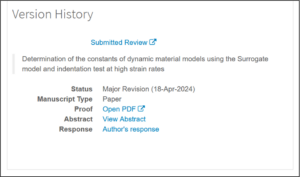
Please note that any author response attachments can be found by clicking on the “Details” tab above the PDF of the manuscript on the reviewer report:

You will then need to scroll down to “Version History”, and click the blue text next to “Response”:

If there is no link in this section, then the author response can be found in our initial invitation email with the previous reviewer reports.

It is generally not appropriate to request additional changes (not mentioned in your original reviewer report) at this stage.

If the author fails to answer your criticisms, please check the ‘Unsatisfactory Revision’ box on the reviewer report form and describe the areas that were not addressed in the revision in your comments.

You will be invited to update the original quality assessment scores you provided with your original review. If you feel the paper has been improved, your scores should increase.

You will be asked to give a recommendation. The editor will take into account your recommendation along with those provided by any other reviewers. Your recommendation should be either:

  • Accept
  • Amendments required before acceptance
  • Unsatisfactory revision


Using ScholarOne

We manage all our submissions and peer review through a web-based system called ScholarOne. It is really easy to set up your account and keep it up to date.

Watch this video to find out how to set-up a ScholarOne account.

ScholarOne now supports login and account creation via your ORCID iD. See our ScholarOne login and account creation via ORCID iD guide for further details.


How to create an account on ScholarOne

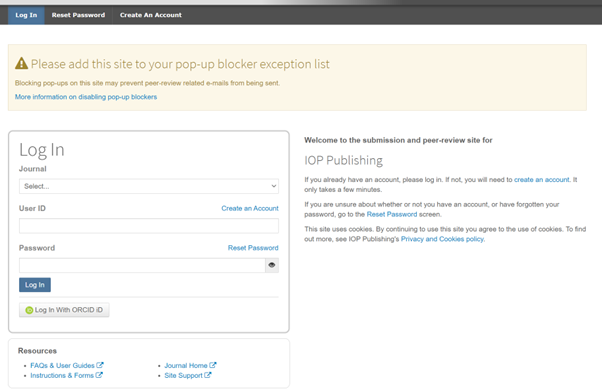
1) Follow this link to access ScholarOne

2) Select ‘Create an Account’ on the toolbar:

3) Associate an ORCID iD to your account. Then fill in your name and email address, then select ‘Next’:

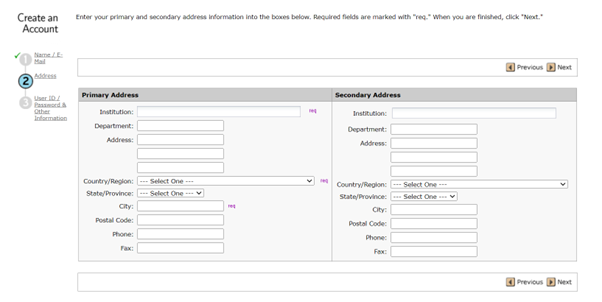
4) Enter details for your institution, then select ‘Next’:

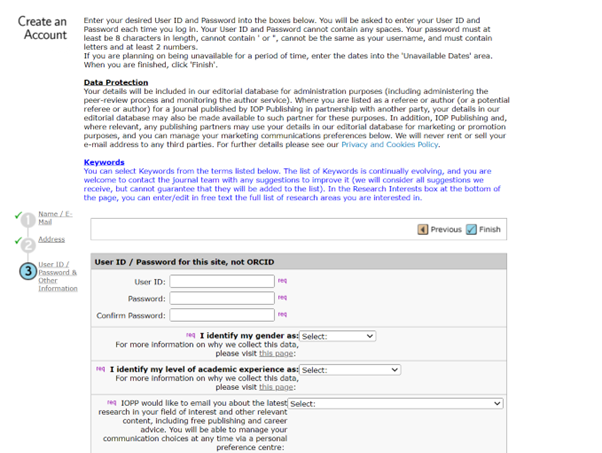
5) Enter a User ID and Password. Select your gender and level of academic experience. Select if you would like to be contacted by IOP Publishing. Check the box to be invited for peer review, then scroll down:

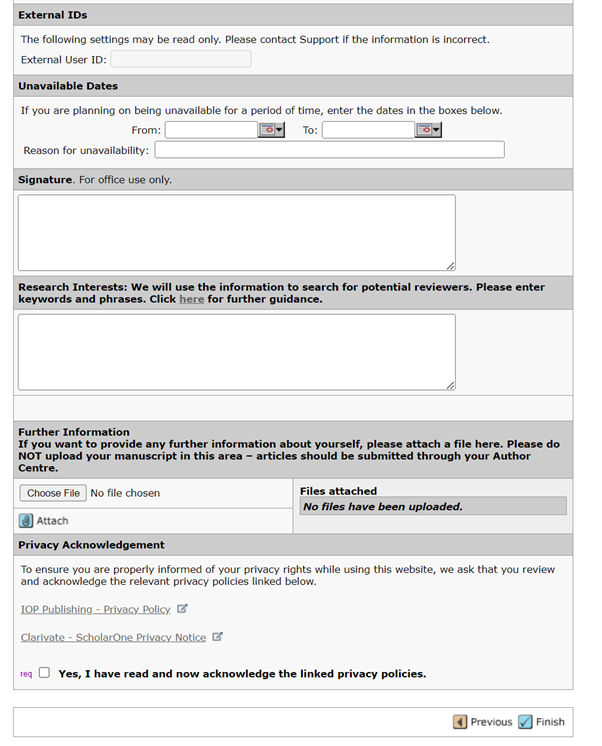
6) Under ‘Unavailable Dates’, let us know when you are unavailable to prevent us from inviting you in this period of time. Fill in the section ‘Research Interests’. Read the IOP Publishing – Privacy Policy and the Clarivate – ScholarOne Privacy Notice, then check the box. Finally, select ‘Finish’:

Watch this video to find out how to update an existing ScholarOne account.


Updating your availability on ScholarOne

If you are planning on being unavailable for a period of time, please enter the dates into the ‘Unavailable Dates’ section of the ‘User ID/Password & Other Information’ area of your ScholarOne account. This will help ensure we do not send you requests to review a manuscript while you are unavailable.


Adding your research interests to ScholarOne

We recommend making sure that your research interests are detailed and up to date. Use these tips to maximise your chances of being selected:

  • Avoid abbreviations
  • Use as many keywords as possible: try to use as broad a range of terms as possible, including any synonyms or closely related fields
  • Separate each term with a comma, with no unnecessary commentary

Here is an example of a good list of research interests:

magnetic nanoparticle characterization, magnetic particle imaging, magnetic nanothermometer, measuring instruments, weak signal detecting, iron oxide nanoparticles, magnetic nanoparticle thermometer, magnetic nanoparticles, biofunctionalization, dc magnetic field, magnetic fluid, magnetic particle susceptibility imaging, magnetic susceptibility imaging, magnetonanothermometry, phase delay, real-time and quantitative abilities, signal bandwidth, spatial resolution


How to submit your reviewer report on ScholarOne

To submit your reviewer report, either click the link in the email you received with the paper attached, or log into your account on ScholarOne. If you have forgotten your log in details, click ‘Reset Password’ on the log in page. This video will take you through the stages of submitting your reviewer report.

Watch this video to find out how to submit your reviewer report on ScholarOne.


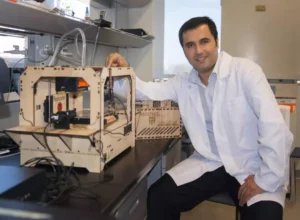
Dr Ozbolat, Penn State University, The United States


Dr OzbolatDr Ibrahim Tarik Ozbolat is professor in the Engineering Science and Mechanics Department of Penn State. He is a specialist in 3D bioprinting, artificial organs, and regenerative medicine and has recently published research in Biofabrication which looks at a new way to generate microgels; High-throughput microgel biofabrication via air-assisted co-axial jetting for cell encapsulation, 3D bioprinting, and scaffolding applications. This was published open access under the transformative agreement with Big Ten Academic Alliance.

Can you tell us about your latest findings?
Our latest study shows a new technique to make larger quantities of microgels in a much easier way. Due to their properties, microgels are gaining immense attention for use in tissue repair and regeneration. Currently, there are several microgel fabrication techniques, but their wide usage is challenged as they are expensive and time consuming.

With our new technique we can produce more microgels which can be used to create self-healing materials, drug-delivery systems and bioinks to assist 3D imaging of human tissues and organs. Our study has the potential to accelerate tissue engineering technologies and improve the quality of life for many people.

Why did you decide to publish the research open access?
I believe that the democratization of scientific knowledge is essential, and one way to accomplish this goal is by making research open to access. By removing barriers to accessing scientific information, we can ensure that everyone, regardless of their background or financial resources, has the opportunity to engage with and benefit from scientific research. Open access publishing is also an excellent way to make scientific information available to a broader audience, including researchers, policymakers, healthcare professionals, and the general public.

What benefits did you see from publishing your work open access?
Publishing our research open access did lead to some surprising outcomes. One of the most notable things that happened was the increased visibility of our work. By making our article freely available, we were able to reach a much wider audience. As a result, we received more downloads and views of our article than we had anticipated. Additionally, some researchers working in the same field reached out with queries or for possible collaborations.

Did the transformative agreement make it easier to publish open access?
Typically, when publishing research is supported by the National Institutes of Health (NIH) funding agency, it is published on platforms like PubMed. However, the publication process can sometimes be time-consuming, with a delay in online availability. The transformative agreement streamlined the publication process, ensuring that our research was made available online as soon as it was accepted.

You can read the full interview with Dr Ozbolat here.

Magnus Jonsson, Linköping University, Sweden


Magnus Jonsson received the Journal of Optics Emerging Leaders Award for his outstanding research, Highly reflective optical nanocavities for structural coloration by combining broadband absorber and Fabry–Pérot effects. It was published open access in Journal of Optics, under the transformative agreement with the Swedish BIBSAM consortium.

How easy was it to publish open access under the transformative agreement?
It was easy and quick, which is important for us so that we use our time for the research and article writing. We have grants that instruct us to share our research findings open access. Publishing open access is rather standard for us, via open access in scientific journals and also by posting preprints.

Did it lead to anyone surprising seeing your work?
Our paper has received significant attention, which is great. Besides researchers, we are sometimes approached by companies that have read about our research and some of them may not have had access to the articles unless they were published open access.

What are the next steps for your research?
We are excited about several directions right now. As direct follow-up on the research on structural colors published in Journal of Optics, we have now managed to make the colors dynamically tuneable, by implementing an electroactive conducting polymer as the spacer layer of the optical cavities.

Why do you think it’s important to be able to publish open access?
Sharing the research results with the community is one of the most important aspects of the whole research process. It is important that other researchers, as well as industry and society, have access to read about the latest findings. Likewise, access to others’ research findings is essential for our own research.