Skip to content
IOP Science

Dr Chris Marsh, University of Saskatchewan, Canada


Dr Chris Marsh

Along with two other researchers, Christopher Marsh validated the cutting-edge global-extent “forest and buildings removed Copernicus digital elevation model” (FABDEM) for accuracy. Their research provides confidence in space-based topography mapping, especially in canopy filled mountain terrain. Read Christopher Marsh’s article in Environmental Research Communications: Validation of FABDEM, a global bare-earth elevation model, against UAV-lidar derived elevation in a complex forested mountain catchment


Congratulations on your latest paper. Can you please briefly explain the research that was published?

In the Earth Sciences, satellite imagery is used extensively to map and study terrain. A persistent problem in space-based observation and topography models is that tree canopies and urban canopies lead to overestimation of elevation. Last year, researchers released a global-coverage digital elevation dataset called FABDEM that uses machine learning to remove the artifacts of vegetation and buildings from mapped terrain. This dataset thus offers maps of the bare earth, denuded of canopies and with improved precision.

Our work is an independent evaluation of the accuracy of the FABDEM dataset. We compared the global FABDEM dataset to elevation measured using a LIDAR sensor mounted on an unmanned aerial vehicle (UAV). LIDAR is short for Light Detection and Ranging. It is a method used to image the surface of the earth remotely. UAV-LIDAR provides the highest resolution and accuracy possible for elevation mapping beneath forest canopies and represents the best estimate of the “true” elevation. We evaluated the dataset in one of the trickiest locations—steep, forested mountain terrain. We found that the FABDEM global-coverage dataset was comparable to the UAV-LIDAR dataset and was best-in-class when compared to other existing and commonly used vegetation-removed datasets.

Do you have any personal motivation for studying this topic?

As hydrological modelers and field researchers, we depend heavily on good digital representations of the topography across basins and regions. As mentioned previously, removing vegetation and urban canopies is crucial to improving the accuracy of space-based elevation measurements. FABDEM is the latest database of elevation data. But it needs to be tested and validated. Being able to validate next-generation datasets with our own highly detailed LIDAR observations gives us confidence in these datasets. This is what motivated this study.

What do you imagine are the potential real-life applications of your research, or how will it affect people’s lives in the long term?

The FABDEM dataset is considered one of the best global-coverage datasets. However, because it includes the biases of forest canopies, it is considered less useful for certain types of hydrological modeling and ecological studies, especially in rugged mountain topography. Thus, the machine-learning dataset can potentially be used if it is proven to be accurate in such locations. Also, the steep, forested mountain areas are typically poorly represented in many datasets. So, having an independent evaluation in this location can give other researchers further confidence in using the FABDEM dataset.

Can you describe the process of publishing through a transformative agreement with IOPP?

It was very effortless and automatic. Our institution was clearly listed as having signed the transformative agreement with IOPP. Therefore, it all worked out seamlessly throughout the submission, review, and publication process.

What do you think are the advantages of publishing through a transformative agreement?

Publishing open access is critical for maximizing research impact and ensuring widespread dissemination of research findings. Being able to do so at no cost is important for us researchers, and it removes any hesitation to publish open access. Normally, publishing open access incurs a significant cost—so consideration is limited to if/when funds are available and specific papers. The transformative agreement gives researchers the financial freedom to share more of their valuable work with the world.

What is your advice for other authors looking to publish open access through transformative agreements?

It was not an agreement we were previously aware of; therefore, I would encourage other authors to check if their institution is a partner proactively!

Example Figures

To make your figures accessible to as many readers as possible, try to avoid conveying information using only colour differences. In graphs and plots use symbols, labels, line styles or fill patterns to indicate different data, in addition to different colours.

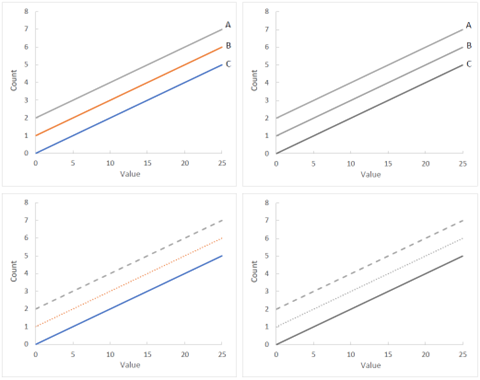
Demonstration of using labels or line styles so that information is clear when figures are converted to greyscale. Left panels show lines in different colours which are very similar when converted to greyscale (right panels). The lines are easy to distinguish by using either labels (top panels) or line styles (bottom panels).

Figure 1. Demonstration of using labels or line styles so that information is clear when figures are converted to greyscale. Left panels show lines in different colours which are very similar when converted to greyscale (right panels). The lines are easy to distinguish by using either labels (top panels) or line styles (bottom panels). The same principle can be applied to other types of chart.

It is not always possible to have good colour contrast or to use labels or symbols, for example with photographic images or colour gradient maps.

For all figures it is important to use the figure caption to provide a description of the information that the figure conveys so that all readers, including those using screen-reader technology, can understand why the image is present. Figure captions must be understandable without needing to refer to the main text of the article.

Figures 2-5 are examples taken from published articles to demonstrate use of the figure caption to describe the information that the image conveys.


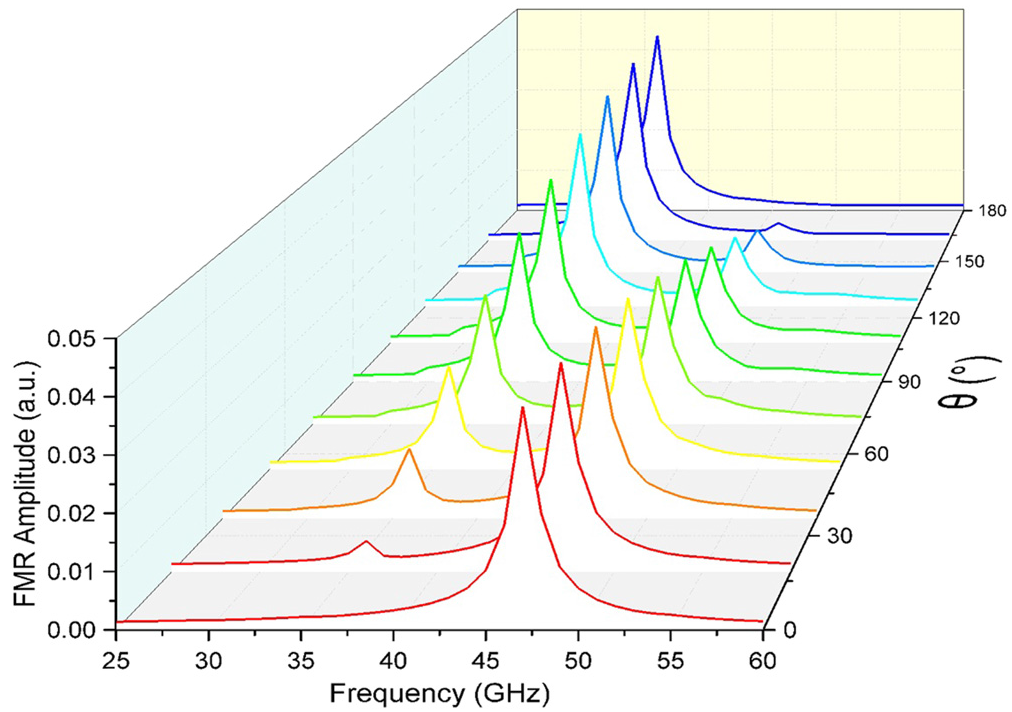
Figure 2. FMR response curves of PMA–SAF as a function of the phase factor θ of microwave fields. Here H0 = 2 kOe, h0 = 30 Oe and θ varies from 0° to 180°. The resonance signal amplitude of the LH mode increases while that of RH mode decreases with θ increasing. [Example figure taken from Chen X et al 2021 New J. Phys. 23 113029 https://iopscience.iop.org/article/10.1088/1367-2630/ac3556]


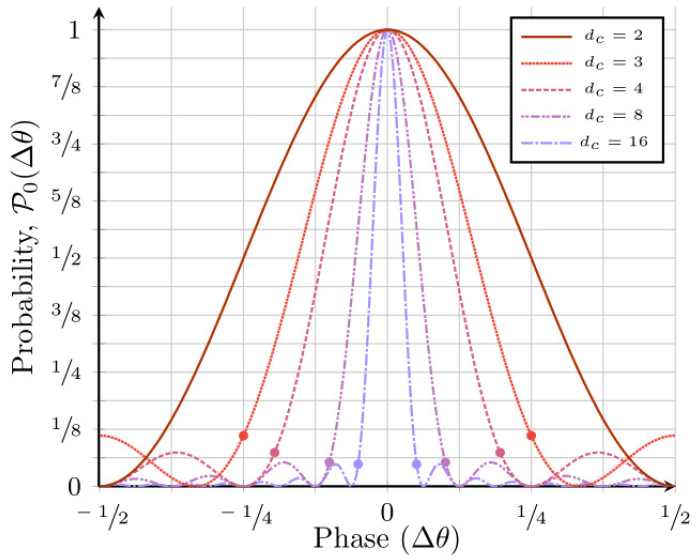
Figure 3. Plot of 𝒫0θ) (equation (3)) from Δθ ∈ [−.5, .5) for various dc . Note that 𝒫0 has infinite domain with period 1. Probability of the (dc -level) control register of an IPEA collapsing to |0⟩ as a function of difference between the eigenphase θ and the applied rotation θR , ΔθθθR for an eigenstate input. Note that when the applied rotation matches the eigenphase (Δθ = 0), the control collapses to |0⟩ deterministically. Denote the region around Δθ = 0 (from dot to dot) as the central lobe of 𝒫0θ), and the small lobes with local maxima outside of it as the sidelobes. See that the higher the system’s dimensionality, the narrower the probability curve’s central lobe and the lower local maxima in the sidelobes. Note that dc = 2 has no sidelobes (the probability is monotonic on either side of the central lobe). Also note 𝒫0θ) = 0 for Δθ = dc-1 and the width of the central lobe is therefore ΔθFWHM = 2 dc-1. [Example figure taken from Moore A J et al 2021 New J. Phys. 23 113027 https://iopscience.iop.org/article/10.1088/1367-2630/ac320d]

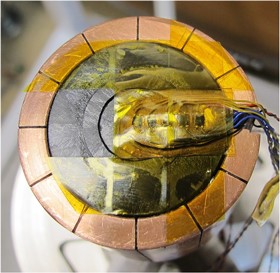
Three Hall sensors are positioned on the inner core, and two sensors are on the ring.

Figure 4. Sample assembly arrangement. Three Hall sensors are positioned on the inner core, and two sensors are on the ring. The distance between adjacent sensors is 2.5 mm. A further sensor is placed inside the bore of the ring. [Example figure taken from Zhou D et al 2020 Supercond. Sci. Technol. 33 034001 https://iopscience.iop.org/article/10.1088/1361-6668/ab66e7]

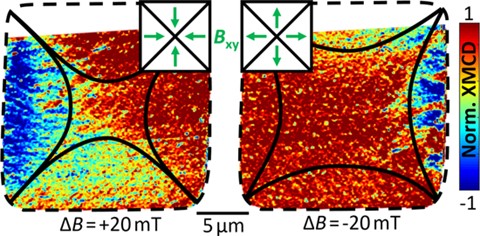
Local XMCD pattern inside the YBCO(250 nm)/Py(50 nm) bilayer at T = 26 K after zero field cooling. The positions of the flux fronts/d-lines are marked by black lines.

Figure 5. Local XMCD pattern inside the YBCO(250 nm)/Py(50 nm) bilayer at T = 26 K after zero field cooling. The positions of the flux fronts/d-lines are marked by black lines. (Left) Increasing the external magnetic field from −40 to −20 mT (ΔB = +20 mT) leads to supercurrents flowing clockwise inside the sample. Here, the local magnetic field points towards the center of the square enhancing the penetration of magnetic flux (black lines). (Right) In case of ΔB = −20 mT (+40 to +20 mT) supercurrents flow anti-clockwise, reversing the latter effect. [Example figure taken from Simmendinger J et al 2020 Supercond. Sci. Technol. 33 025015 https://iopscience.iop.org/article/10.1088/1361-6668/ab54ab]

Dr. Peter J. Riggs, Australian National University, Australia


Dr. Peter J. Riggs from the Australian National University, a physicist and philosopher of science, is exploring ways to better teach and communicate basic concepts in physics, both to improve our understanding of physics, and to prevent misconceptions from being perpetuated. His article, Energy and Mass Misconceptions was published open access in Physics Education, under the transformative agreement with the Council of Australian University Librarians.

Congratulations on your latest paper. Why is the theme of your article, people’s understanding of energy and mass, important? 

Much of my research examines the foundations of physics. The nature of energy and mass are essential concepts in this field of science. Energy, for instance, is fundamental to all physical processes but still needs to be better understood. 

Reading your article gives the impression that you are worried about the current state of physics education. Do you have any personal motivation for studying this topic? 

In parallel to my research endeavours, I have a strong desire to communicate basic physics concepts clearly and intelligibly.  This arises, in part, because as a student, I found that the teaching of such concepts was not always accurately done, and there was insufficient attention to student understanding.  

What are some specific real-life applications of your research and how will they affect people’s lives in the long term? 

A better understanding of the nature of energy will likely assist in finding new ways to develop and utilise non-polluting / environmentally friendly sources of energy. Such energy sources will be crucial in the fight against global warming. 

You published this article through a transformative agreement (TA) with IOP Publishing. How was the experience? 

IOP Publishing has made publishing through the TA with the Council of Australian University Librarians (CAUL) an easy process. Publishing open access now takes no more effort than what was required before the CAUL agreement came into effect. 

What do you think are the benefits of publishing through a TA? 

There are some major advantages, especially the degree to which one’s articles may now be read by physicists, physics teachers and anyone who is interested, at no cost to themselves or their institutions. 

What is your advice for authors who want to publish open access through TAs? 

In light of the advantages of publishing open access, I would encourage other researchers and physics education professionals to seek out relevant journals with transformative agreements. 


Researchers from Australia

IOP Publishing (IOP) has transformative agreements with a number of institutions in Australia to enable a transition to open access publishing.

Who can benefit?
All corresponding authors that are current staff members, researchers (permanent, temporary and visiting), or students at one of the institutions below at the point of submission, can publish open access at no cost to themselves. The corresponding author is the person listed as Corresponding Author at the time of submission, and is the person responsible for communicating with the journal during the peer review and publication process.

What’s included?

  • Accepted articles will be eligible for transformative agreement funding to enable authors to publish open access with no cost to themselves
  • Research paper, Focus Collection, letter and review article types
  • Included journals are those in lists A, B, C and D. Click here for a full title list of eligible journals.

Please note
You may find our author guide for submitting under a transformative agreement helpful located in our Transformative Agreement hub.
For more information, please contact your relevant library contact at your university.

Eligible institutions

Council of Australian University Librarians (CAUL):

Australian National University
Australian Nuclear Science and Technology Organisation (includes Australian Synchrotron)
Curtin University
Deakin University
Flinders University
Griffith University
La Trobe University
Macquarie University
Monash University
Murdoch University
Queensland University of Technology
Royal Melbourne Institute of Technology
Swinburne Technology University
University of Adelaide
University of Melbourne
University of New South Wales
University of Newcastle
University of Queensland
University of Southern Queensland
University of Sydney
University of Tasmania
University of Technology Sydney
University of Western Australia
University of Wollongong
Western Sydney University

Is your institution not listed here? Recommend open access funding to your library.

Researchers from New Zealand

IOP Publishing (IOP) has transformative agreements with a number of institutions in New Zealand to enable a transition to open access publishing.

Who can benefit?
All corresponding authors that are current staff members, researchers (permanent, temporary and visiting), or students at one of the institutions below at the point of submission, can publish open access at no cost to themselves. The corresponding author is the person listed as Corresponding Author at the time of submission, and is the person responsible for communicating with the journal during the peer review and publication process.

What’s included?

  • Articles accepted will be eligible for transformative agreement funding to enable authors to publish open access with no cost to themselves
  • Research paper, Focus Collection, letter and review article types
  • Included journals are those in lists A, B, C and D. Click here for a full title list of eligible journals.

Please note
You may find our author guide for submitting under a transformative agreement helpful located in our Transformative Agreement hub.
For more information, please contact your relevant library contact at your university.

Eligible institutions

Council of Australian University Librarians (CAUL):

  • Auckland University of Technology
  • University of Auckland
  • University of Canterbury
  • Victoria University of Wellington
  • University of Waikato

Earth Sciences New Zealand

Is your institution not listed here? Recommend open access funding to your library.
Professor Lipton-Duffin and Professor MacLeod, Queensland University of Technology, Australia


Professor Jennifer MacLeod

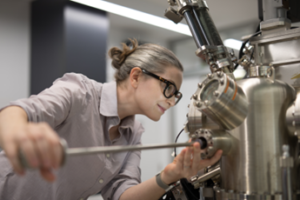
Professor Josh Lipton-Duffin and Professor Jennifer MacLeod (pictured) from Queensland University of Technology are studying molecular reactions on solid surfaces in an effort to synthesize new and useful materials. Read their article: Innovations in nanosynthesis: emerging techniques for precision, scalability, and spatial control in reactions of organic molecules on solid surfaces

This was published open access in Journal of Physics: Condensed Matter, under the transformative agreement with the Council of Australian University Libraries.

Congratulations on your latest paper! Could you tell us about your surface science-based approach to synthesizing new organic materials and why it is so different?

Jennifer: Our approach focuses on understanding how molecules and atoms behave on surfaces and whether we can control this behavior to produce useful new materials. We treat molecules like building blocks that can be used to create one- and two-dimensional structures with interesting chemical, electronic or structural properties.

Josh: A lot of industrial-scale processes, say, for example, the fabrication of various materials, are arrived at through exhaustive trial and error, but the fundamental process (or what happens at the atomic scale) remains a bit of a mystery. This is because studying real-world processes is quite complicated; physicists must deal with multiple atoms and molecules in multiple configurations to do so, and that’s very challenging. But that’s what we’re doing. We study these processes atom by atom and molecule by molecule.

What motivated you to look at molecular reactions on solid surfaces, and materials synthesis in particular?

Josh: I am a bit of a gearhead, and I love taking things apart and putting them back together. So, my motivation was both bottom-up and top-down. On the one hand, putting together new materials from molecular building blocks is a very small version of my childhood obsession with Lego blocks. On the other hand, we get to use, tinker with, and build some pretty awesome instrumentation, which not only looks impressive but also keeps us on the cutting edge of a lot of technologies.

Jennifer: I’ve got quite a few reasons. The first is that I’ve always found images of atoms to be amazing and beautiful, and getting to “see” atoms on a daily basis never fails to be a thrill. The second is that we get to create and understand tiny little things that have never existed before, which is also awesome. The third is that the work is so varied and continually challenging, it never gets boring! One day can be spent with a wrench in hand, taking apart a vacuum chamber or building instruments, and the next can be spent doing calculations to understand the thermodynamic properties of candidate structures.

How do you suppose your research will improve people’s lives in the long run?

Josh: In terms of ‘practical’ things, we are low on the technology readiness scale. But I very much hope that our work can support future development of technologies by bright minds who are good at that sort of thing.

Jennifer: Yes. Right now, this work is fundamental. But in the larger picture, the materials we synthesize might have certain properties required for their use in next-generation technologies and might make a difference to future-focused challenges around energy, information, and sustainability. These materials can exhibit exciting quantum properties that unlock a whole lot of interesting applications. And that holds immense potential.

Your paper, which is open access, was published through a transformative agreement that the Council of Australian University Librarians (CAUL) has with IOP Publishing. How would you describe the publication process?

Josh: Pretty seamless! I think it should be the norm across the industry. Honestly, it is far simpler than processes from other publishing houses.

Jennifer: I would use the word “painless”. It was quick and easy.

Do you believe there are advantages to publishing open access, or through a transformative agreement, like this one?

Jennifer: Yes! The biggest one being that it makes our work accessible to everyone interested in reading it, with almost no effort from our side. It also makes meeting the obligations of our funding agreements and institutional policies around open access easy.

Josh: I strongly believe in accessibility—removing barriers for potential readers of science. We get better outcomes when more people can access what we do. Open access should be the default for publicly funded work.

Do you have any words of advice for other authors interested in publishing open access?

Jennifer: They should definitely look into it. It’s been great from my perspective and could be the right fit for others as well.

Josh: I’d agree. Go for it! This is a great way to have individual authors’ work reach more eyes without having to worry about post-hoc costs after all of the research and writing have finished.


How to write your research interests in ScholarOne

Your research interests are important if you would like to be selected to review for IOP Publishing. They are even more important if you have not reviewed for IOP Publishing previously.

You can access your ScholarOne account and add your research interests to your profile.

Please keep your research interests up-to-date on ScholarOne, so that we only send you manuscripts that are in the right research area. After checking your field of study and experience, our editorial team will aim to match you with a suitable manuscript to review as soon as possible.


How to write useful research interests

We recommend making sure that your research interests are detailed and up-to-date. Remember it is important to use both general terms, e.g. ‘quantum physics’, and specific terms, e.g. ‘many body cooling’, so that we can understand your particular area of research. Once you have written your research interests, read them back and consider if an editor would be able to select you for an appropriate manuscript using this information.


Use these tips to maximise your chances of being selected:

  • Avoid abbreviations, especially less commonly used abbreviations.
  • Use as many keywords as possible: try to use as broad a range of terms as possible, including any synonyms or closely related fields.
  • Separate each term with a comma, with no unnecessary commentary.
  • Include techniques that you regularly use in your work, e.g. ‘LCMS, Liquid chromatography-mass spectroscopy, Liquid chromatography mass spectroscopy’.
  • If you only want to review theoretical work, include this in your research interests.


Here is are examples of good lists of research interests in a range of fields:

Magnetic Nanoparticles:

magnetic nanoparticle characterization, magnetic particle imaging, magnetic nanothermometer, measuring instruments, weak signal detecting, iron oxide nanoparticles, magnetic nanoparticle thermometer, magnetic nanoparticles, biofunctionalization, dc magnetic field, magnetic fluid, magnetic particle susceptibility imaging, magnetic susceptibility imaging, magnetonanothermometry, phase delay, real-time and quantitative abilities, signal bandwidth, spatial resolution

Computational Chemistry:

computational materials science, density functional theory, hybrid functionals, many-body perturbation theory, ab initio molecular dynamics, transparent conductive oxides, solar cell materials, semiconductors, metals, magnetic molecules, spinels, perovskites, chalcogenides, kesterites, nitrides, ferrites, amorphous materials, structural properties, electronic properties, band structure, effective mass, magnetic properties, magnetostriction, optical properties, dielectric function, absorption coefficient, spin-triplet superconductivity

Environmental Research:

Environmental Geography; Remote sensing; Geographic Information System; GIS; Geoinformatics; land management; environmental management; natural resources management; ecosystem services; urban environment; urban heat island; coastal likelihood and sustainability; urban planning; Landsat; Sentinel; land surface temperature; urban green spaces; land use land cover changes; urbanization; mapping

Quantum Theory:

quantum optics; quantum state tomography; photonics; entanglement; quantum dynamics; open quantum systems; non-Markovian evolution; time-bin encoding; phase retrieval; quantum Hamiltonian tomography; quantum measurement; decoherence; quantum information; quantum processes; quantum cryptography and communication security; quantum state engineering and measurements; foundations of quantum mechanics; measurement theory

Biomedical:

biomedical engineering, bioengineering, biomedical data analysis, biomedical signal processing, heart rate variability, fetal heart rate variability, electronic fetal monitoring, fetus, magnetic resonance imaging, nanomedicine, microfluidics, drug delivery systems, biomaterials, polymer nanoparticles, biopolymers, lean six sigma, health technology assessment, discrete event systems, discrete event simulation


If you need any help filling in your research interests, please email IOP Publishing’s Peer Review Engagement team at peerreview@ioppublishing.org.

Co-review with a colleague

What is co-review?

Co-review enables two people to collaborate on a reviewer report, with both having the option to receive recognition via Web of Science. Co-review aims to help early career researchers with limited peer review experience build their skills alongside more experienced colleagues or supervisors.

Critiquing manuscripts can deepen early career researchers’ subject knowledge, improve their understanding of how to structure and write papers, and boost confidence in their expertise.


How to co-review on IOP Publishing journals

All reviewers must follow the reviewer guidelines for IOP Publishing journals, including ethics for reviewers and COPE’s Ethical Guidelines for Peer Reviewers.


Co-review FAQs


  • I want to co-review with a junior colleague—what should I do?

If you’re invited to review and want to co-review with a colleague, select the “Co-review with a colleague” link in the invitation email, then enter their name and contact details in the box provided. IOP Publishing handles all data in line with our privacy policy.

If reviewers are still needed, your colleague will be invited to review. If they accept, they will need to share the manuscript PDF with you so you can work on the report together offline. The final report should be submitted via your co-reviewer’s ScholarOne account.

Senior researchers are encouraged to support junior colleagues through the process by:

    • Making sure expectations are clear
    • Setting a timeline to allow them to complete the report but also meet the deadline
    • Reviewing and discussing the report before submission
    • Checking the recommendation aligns with the report content


  • I have been invited to co-review by a senior colleague—what should I do?

If you’re invited to co-review with a colleague, do not select the “Co-review with a colleague” link in the invitation email—please select “Agree” instead.

Once you receive the “Paper now ready to review…” email, you can share the manuscript PDF with your colleague and work on the report together offline.

Although you are responsible for writing and submitting the reviewer report, the colleague who recommended you should support you through the process. When the report is complete and both of you are satisfied, you should submit it to the journal through your ScholarOne account.


  • Is there any additional training or guidance for new reviewers?

Yes—IOP Publishing offers free, online peer review training, tailored specifically for the physical sciences. The training course takes approximately 2 hours to complete and can be accessed here: Peer Review Excellence.

For more information on how to submit a report, you can read our guidance on How to prepare and send in your reviewer report.


  • Can journal board members use the co-review functionality?

Board members should not request to co-review with a colleague, as we rely on your expertise in your field and your knowledge of the journal. Also, there may be problems with confidentiality, so it is inappropriate for your colleague to work on the report.


  • I requested to co-review with a colleague, but they have not been invited yet?

There may be a short delay between you requesting to co-review with a colleague and your colleague being invited. Our editorial team will need to check if more reviewer reports are needed on the manuscript. In some cases, other reviewers will have accepted their review invitations and additional reports are not required.


  • Can I delegate a review to more than one colleague?

If you would like more than one colleague to work on the reviewer report, please contact the journal inbox. We do allow this for a maximum of 3 people, but it is important that our editorial team know who has written the report. Only one colleague will be able to receive the invitation and submit the reviewer report via ScholarOne.


  • Will all co-reviewers receive an evaluation of the report?

No, only the person who submitted the report will receive an evaluation, provided they opt in on the report form. However, all co-reviewers can gain recognition through the Web of Science Reviewer Recognition Service.


Why do we offer co-review on our journals?

At IOP Publishing, we are aware that early career researchers and PhD students will occasionally write reviewer reports on behalf of their supervisors without receiving any credit for their work. Some of the benefits of co-review include:

    • Alleviating the burden for senior researchers who receive many invitations to review
    • Allowing early career researchers to build their peer review competency
    • Providing early career researchers with benefits and rewards for reviewing
    • Ensuring full accountability in peer review, so that everyone who contributes to a review is known to the editorial team

How to write an outstanding reviewer report

Our editors rate all of the reviewer reports we receive on a scale of 1–5, with 5 representing a review of outstanding quality. Click here to read the full breakdown of the reviewer report ratings. These are the criteria to have a reviewer report rated 5 out of 5:

Criteria Level to be rated 5 out of 5
Thoroughness Detailed and very thorough: comments on essentially all sections of the manuscript
Assessment of significance Comments on the significance of the work within the context of the field
Literature comparison Includes a comprehensive comparison with existing literature
Feedback quality Constructive feedback that enables the author(s) to improve the manuscript
Recommendation Recommendation is clearly justified and consistent with the journal’s editorial standards
Timeliness Submitted in the agreed timeframe


These documents contain examples of outstanding reviewer reports in the fields of:


This document contains examples of reviewer reports rated 1, 3 and 5.


Here is a template you can use to help structure your reviewer report:

Comments to the editor/s
These comments will not be shared with the authors. Use this section if there is anything you want to say that would not be appropriate to tell the authors. If you suspect any form of author misconduct, mention it here.
Comments to the author/s
The following is a good way to structure your review.
Summary Open your reviewer report with a summary of the manuscript and its findings. This shows the authors and editors of the journal that you have read and understood the work.
Comments on the manuscript
  • Organise your comments into ‘Major points’ and ‘Minor points’ where applicable.
  • Comment on the originality, scientific rigour, significance and clarity of the work.
  • Compare the manuscript to existing literature. Check that the authors have cited the most relevant and recent appropriate work.
  • Make your review as thorough as possible by commenting on all sections of the manuscript. For example, you could structure your comments using manuscript section headings such as: “Abstract”, “Introduction”, “Methods”, “Results and Discussion”, “Conclusion” and “Supplementary material” (as appropriate).
  • Familiarise yourself with the editorial standards of the journal and comment on whether the manuscript meets those standards.
  • Make sure that your recommendations are specific enough for the authors to follow.
  • It is helpful to number your points. This can make it easier for the authors to respond to your comments and when checking the revised manuscript.
Recommendation At the end of your reviewer report, make a recommendation to the editor. Clearly state and justify your recommendation. This means explaining why you have chosen the reject/revise/accept option.


For more information about reviewing for IOP Publishing, go to our homepage for reviewers.


Peer Review Excellence online course

For the most up-to-date advice on how to assess a manuscript, sign up for our free, comprehensive online training course. Completing the online course is the fastest way to be invited to review.

At IOP Publishing we offer an online course in Peer Review Excellence. We recommend this training to early career researchers and anyone who is submitting their first review. This comprehensive training course is designed to give researchers in the physical sciences the tools and confidence to review well. The course covers the fundamentals of peer review, how to write a review and peer review ethics. Our Peer Review Excellence course takes around 1–2 hours to complete.

If you pass the course, you will be fast-tracked towards IOP Trusted Reviewer status and be badged as a Graduate on our reviewer selection system, making it more likely that you will be selected to review. Also, for reviewers who have completed our Peer Review Excellence training, the threshold for IOP Trusted Reviewer status is reduced to a reviewer report rated 4 or above. Over 50% of all Peer Review Excellence graduates go on to get IOP Trusted Reviewer status when they submit a reviewer report.

This online course will provide you with the skills and confidence to evaluate scientific manuscripts and write an outstanding reviewer report. Importantly, it shows you what the editor is looking out for when they read your report.

Anyone can join the programme, but it is specifically designed for early career researchers or scientists who want to improve their peer review skills.

You can register for free here: Peer Review Excellence.

Please note that in cases where the manuscript editor rescinds a reviewer report due to excessive self-citation, citation manipulation or any other form of reviewer misconduct, the re-submitted reviewer report will receive a maximum rating of 2.

Once you have completed the Peer Review Excellence course and received a review invitation, you can read through IOP Publishing’s information on Becoming a journal reviewer, How to prepare and send in your reviewer report, and After you have submitted your reviewer report.