IOP Publishing (IOP) has a transformative agreement with two instiutions in Slovenia to enable a transition to open access publishing.
Who can benefit?
All corresponding authors that are current staff members, researchers (permanent, temporary and visiting), or students at one of the institutions below at the point of submission, can publish open access at no cost to themselves. The corresponding author is the person listed as Corresponding Author at the time of submission, and is the person responsible for communicating with the journal during the peer review and publication process.
What’s included?
• Articles accepted will be eligible for transformative agreement funding to enable authors to publish open access with no cost to themselves
• Research paper, Focus Collection, letter and review article types
•Included journals are dependent on your eligible institution, please see the below list for details. Click here for a full title list of eligible journals.
First we recommend checking IOPP Journal Finder to see if your institution is covered by a transformative agreement (TA), and your article complies with funder requirements.
Alternatively, visit ‘Transformative and institutional open access agreements’ and select the relevant country to find the agreement you may be covered by. Each agreement page lists all of the member institutions and eligible journals.
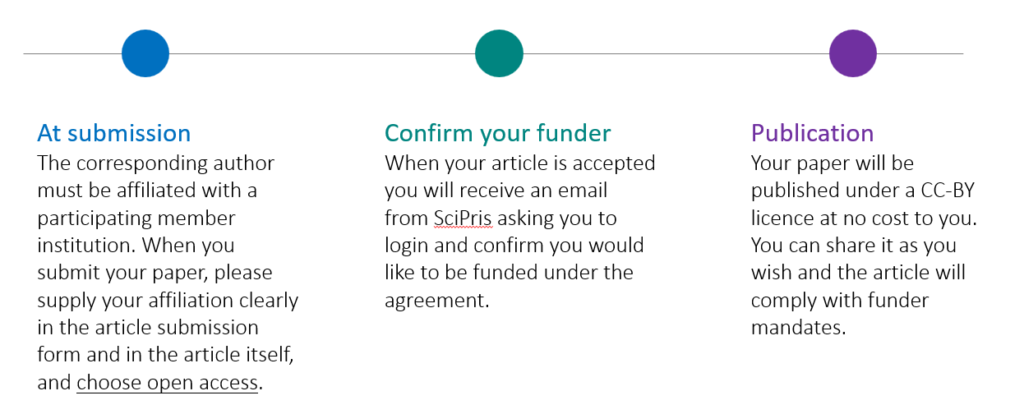
Here is a quick overview of the TA funding process:
In this guide we have focused on the steps that relate to funding your article through a TA. When you are ready to start your submission, follow the steps on our submission system, ScholarOne.
Note: a small number of eligible journals do not use the ScholarOne submission system.
1. Confirm your institution name
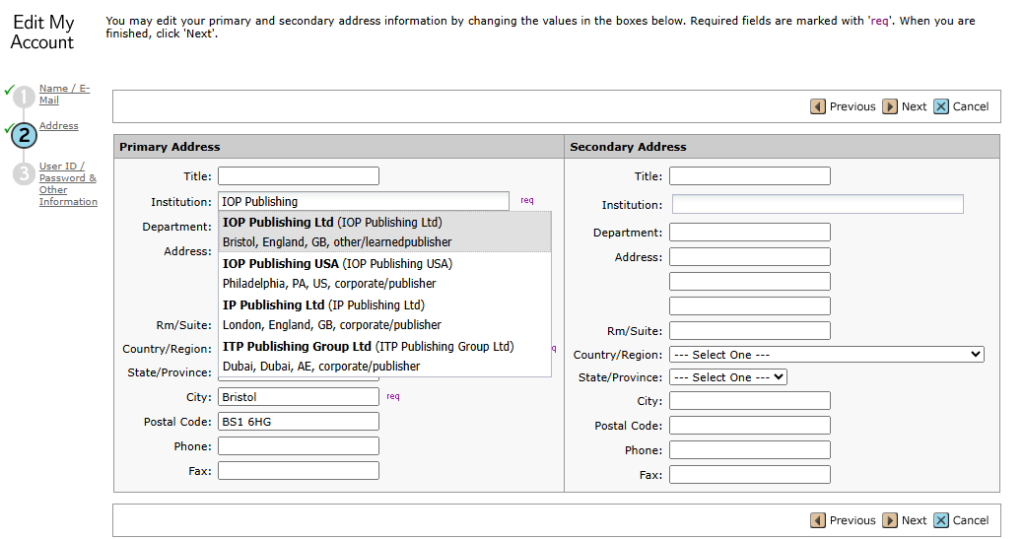
To secure your funding through a TA you must provide an accurate institution name so that we can match your article with the funding available. In ScholarOne, your institutional affiliation is confirmed on step 4 of your submission.
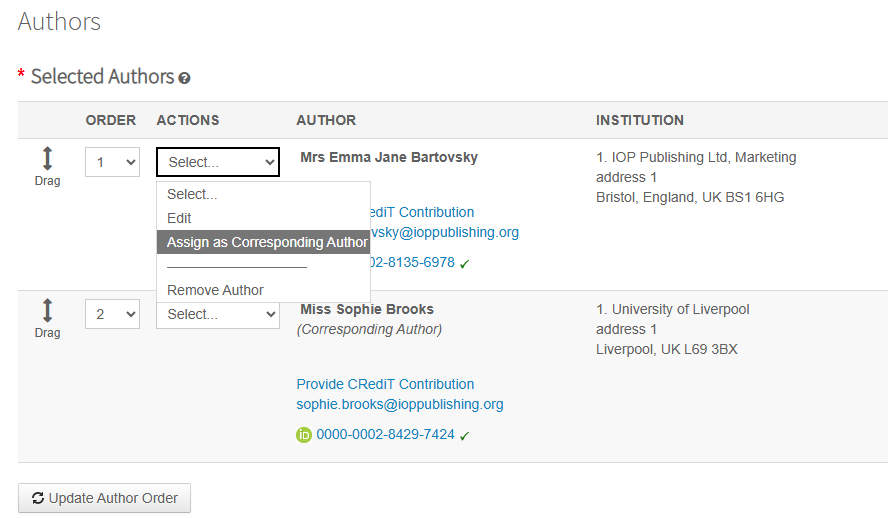
As the corresponding author, your name, institution and OrcidID for your submission will be populated by the information held in your author account in ScholarOne. Any changes to your contact information can be made in your author account.
To change your institution, start typing in the institution field and choose your institution name from the names that match your entry. When selecting your institution, choosing from the autofill list of matching institutions will help us to identify your paper for TA funding. We recommend you type your institution name first, rather than your department or laboratory name. If you cannot find your institution in the list, you can type it – please take care to spell it correctly with no additional spaces.
Funding eligibility is always based on the affiliation of the corresponding author. The corresponding author is the person listed as Corresponding Author at the time of submission and is the person responsible for communicating with the journal during the peer review and publication process.
2. Choose open access
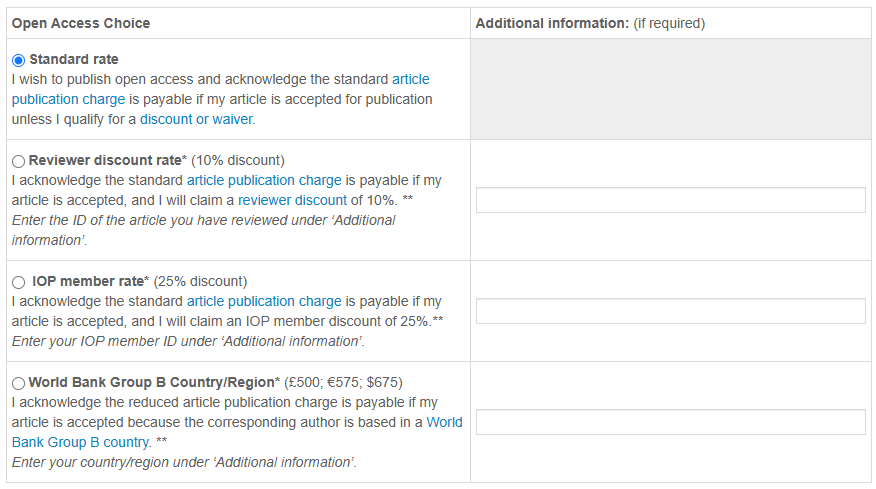
At step 6 in ScholarOne you will see options for publishing your article open access. The options will vary depending on whether you are submitting to a hybrid or fully open access journal, and if there are waivers that may be available to you.
It is possible to change your open access choice between submission and acceptance, so you may want to check your funding options again using the IOPP Journal Finder Tool, before you sign your copyright. Funding through the TA may be declined if your agreement has an article cap that has been met, or if your agreement is validated by a contact within your institution, who declines funding.
Typical hybrid journal open access options are seen below. If you discover that you may be eligible for TA Funding, you should select: Yes: Standard rate.
Typical fully open access options are seen below.
Important: If you choose to publish open access and your article is not eligible for TA funding, or if funding is declined by your institution, you will receive an invoice for the article publication charge. If you think that you are owed funding, please contact openaccesscharging@ioppublishing.org so we can confirm for you.
3. Confirm your funding request
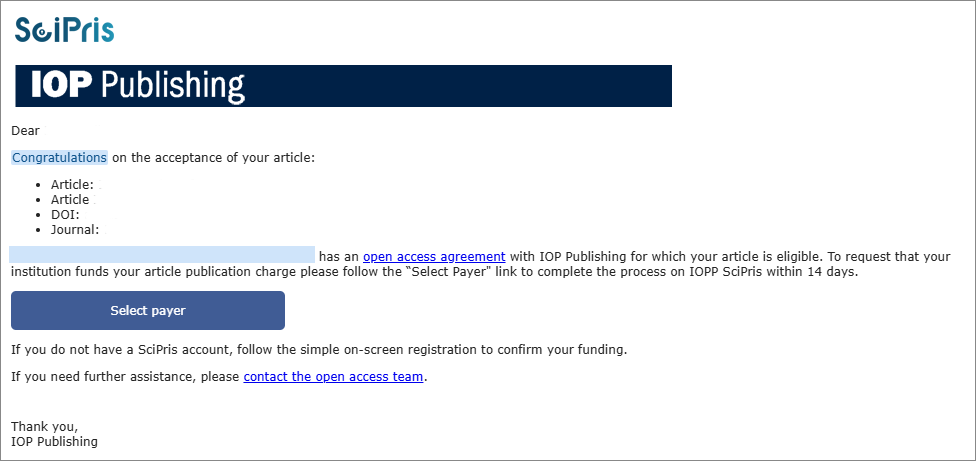
After your article is accepted for publication, you will receive an email from our SciPris open access funding platform.
• the sender will be IOPP Open Access <no-reply@scipris.com>.
• the subject line will be ‘Action required: Your APC is eligible for open access funding – complete your request for <article ID>’
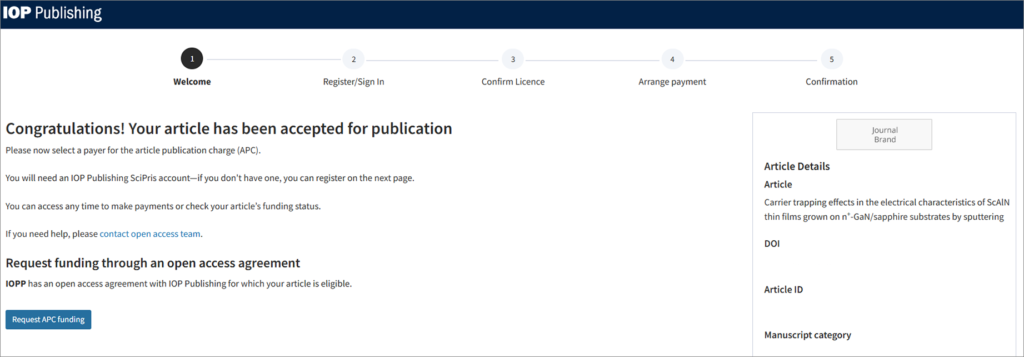
The email will ask you to register or login to SciPris via the IOPP Identity Hub, to confirm that you would like to request funding for your article via your institution’s open access agreement. To assign your institution as the payer, follow these steps:
On the welcome screen, click on the button to ‘Request APC funding’:
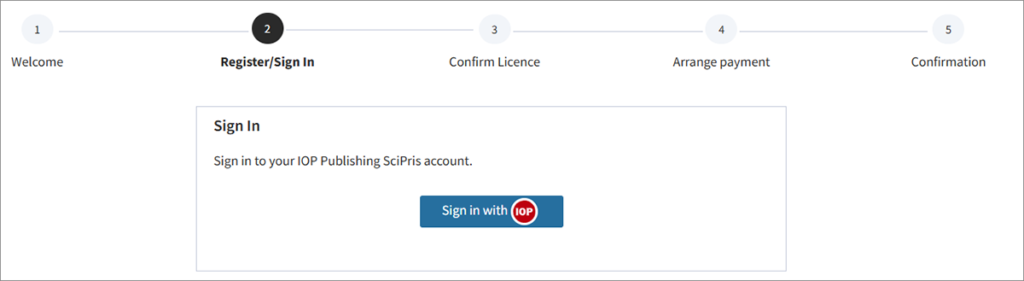
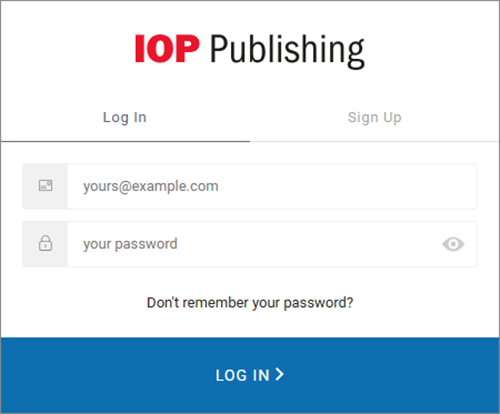
Register/sign in via the IOPP identity hub. You may already have a login via your ORCID account. If not, it is very quick and easy to sign up.
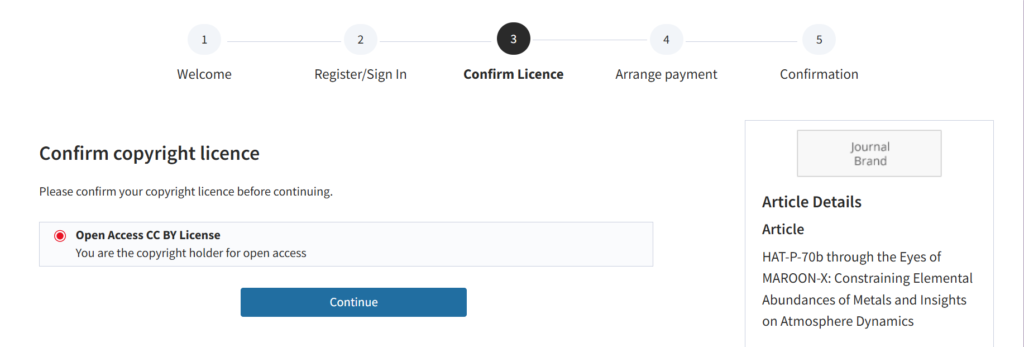
When you have completed the login you will be returned to SciPris and asked to confirm your copyright licence. The Open Access CC BY licence will already be selected. Click ‘Continue’ to proceed.
On the next page, click on ‘Submit request‘
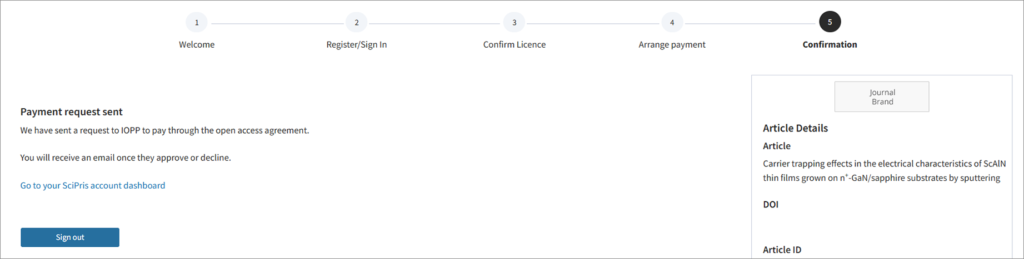
You will see a confirmation screen
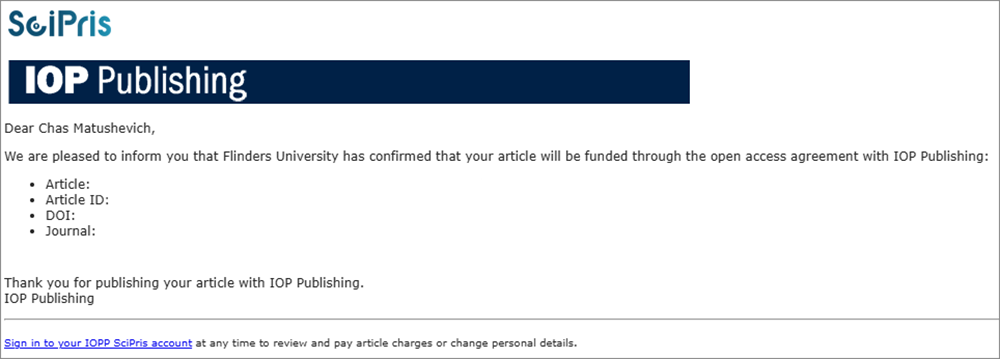
Depending on the terms of the agreement, you will either receive an instant confirmation of funding, or you will receive a funding decision within 5 days of your request.
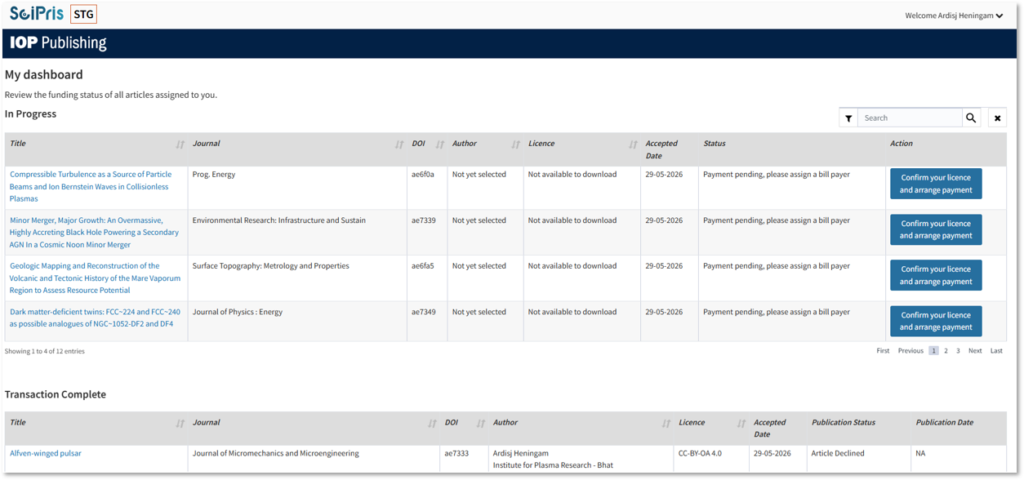
You can login to SciPris to see the status of any articles you have requested funding for on your author dashboard. This will show you articles for which you are the corresponding author, and for which funding has been requested. You can also see those that are pending your institution’s decision and those that have been published.
To check your contact information in SciPris, go to the ‘welcome’ link in the top right of the screen. You can update some of your details directly on SciPris. This will only update your SciPris profile, and not your Scholar One profile. However, your email address cannot be edited, as the dashboard can only be associated with one email address.
How to Complete Your APC Funding Request | SciPris Tutorial
Signing your copyright form to publish under a transformative agreement
Watch our short video to find out what the CC BY licence covers, why it’s important, and how to sign it.
Do I need permission to reuse IOP material for which I was the original author/co-author?
All IOP authors who publish on a subscription basis may include original figure(s) and text from articles they have written, within the quota outlined in the STM Guidelines, in new works created or co-created by them, provided that they notify IOP of their intended use. Where there are co-authors, you should inform them. Use which is not covered by the STM Permissions Guidelines, or which exceeds the STM Permissions Guidelines quotas, will require IOP’s permission (See “Reusing IOP Published content“). You must always cite the publication from which the figure(s)/text was taken.
If your article was published on an open access basis, you can use it without permission provided the relevant CC licence terms are adhered to.
Can I use my subscription article as part of my thesis/dissertation after it has been published with IOP?
What are the different versions of my article and how can I use them?
Author’s Original/Preprint is the version of the article before peer review or editing, as submitted by an author to the journal.
Accepted Manuscript is the version of the article accepted for publication, including all changes made as a result of the peer review process, and which may also include the addition to the article by IOP Publishing of a header, an article ID, a cover sheet and/or an ‘Accepted Manuscript’ watermark, but excluding any other editing, typesetting or other changes made by IOP Publishing and/or its licensors’.
Final Published Version is ‘the peer reviewed, edited, formatted and typeset version of the article, including any tagging, indexing and other enhancements published by IOP Publishing and/or its licensors’.
Version of Record is ‘the Final Published Version, including any post publication corrections or enhancements and any other changes made by IOP Publishing and/or its licensors’.
For information on permitted reuse for each of these versions, please refer to our Author Rights Policy
May I reuse supplementary material forming part of the article?
Authors retain copyright in any supplementary material, granting IOP a non-exclusive licence to reproduce it. You may reuse supplementary material to which you own the rights. This includes reuse of a video abstract, although you may need to obtain separate permission from the copyright owner for any third party content you included within it. The video abstract should reference the article, and, wherever possible, should provide a link back to the Version of Record of the article to which it relates.
Can I use IOP published content for lecture and classroom purposes?
If your institution is an IOP subscriber, use of this kind may be included in your licence; please check with your librarian. Non-subscribers may be permitted to do this under the terms of a licence from a local reproduction rights organisation (RRO). In the UK, this will be the CLA and in the US, the CCC. Pay-per-use permission for photocopying and electronic use is available via the CCC.
Do I need permission to adapt an IOP figure?
Generally, adapted figures require the permission of the copyright owner of the original figure. You do not require permission if the figure you have created is so different from the original that it is no longer recognisable. This is judged on a qualitative not a quantitative basis. Therefore, even if you have only used one small part of the original figure, you will probably still require permission. Changing the font, colour or size of the figure, or only using part of it, still requires permission.
How do I gain permission to use content from IOP conference series?
The content in IOP Publishing’s Conference Series journals are all published on a gold open access basis. From around Dec 2012, all of our conference series articles are published under a CC BY Licence. For further information on this, please see CC Licences. Older conference series articles were not published under a CC BY licence. You should check the licence on the article itself prior to use. If the article was not published under a CC BY licence or the article does not state what licence the article was published under, please contact permissions@ioppublishing.org to request permission if you wish to reuse any content from the article.
Can I reuse IOP Published content in a new work to be published by IOP?
If you are submitting an article to be published by IOP, you may include original figure(s) from articles published in a journal owned by IOP or in a partner journal for which IOP handles permissions in new works created or co-created by you. You must always ensure that you have cited the prior publication from which the figures were taken. However, if IOP does not accept the article, and you wish to submit the article to another journal not published by IOP, you must obtain express permission from IOP to reuse any figures. If you wish to use figures published under the subscription model by one of our partner journals who handle their own permissions, you must contact the partner to request permission.
What are Green/Gold Open Access articles and where can I reuse them?
IOP Publishing (IOP) has a transformative agreement with a number of Swiss institutions through the Consortium of Swiss Academic Libraries to enable a transition towards open access publishing.
Who can benefit?
All corresponding authors that are current staff members, researchers (permanent, temporary and visiting), or students at one of the institutions below at the point of submission, can publish open access at no cost to themselves. The corresponding author is the person listed as Corresponding Author at the time of submission, and is the person responsible for communicating with the journal during the peer review and publication process.
What’s included?
• Articles accepted will be eligible for transformative agreement funding to enable authors to publish open access with no cost to themselves
• Research paper, Focus Collection, letter and review article types
• Included journals are those in lists A, B, C and D. Click here for a full title list of eligible journals.
Please note
Funding is subject to librarian funding approval at acceptance stage. If for any reason funding is declined, the author(s) will have the opportunity to revert to subscription publication type at zero cost to themselves or the member institution.
Discover high impact papers published through this agreement in our celebratory collection.
Eligible institutions
Basel University
Bern University
Fribourg University
Geneva University
Library for the Research Institutes within the ETH Domain: Eawag, Empa, PSI & WSL:
Swiss Federal Institute of Aquatic Science and Technology
Swiss Federal Laboratories for Materials Science and Technology
Paul Scherrer Institute
Swiss Federal Institute for Forest Snow and Landscape Research
HES-SO – University of Applied Sciences and Arts of Western Switzerland
Lucerne University of Applied Sciences
OST Eastern Switzerland University of Applied Sciences
Swiss Federal Institute of Technology Lausanne (EPF)
Swiss Federal Institute of Technology Zürich (ETH)
University of Applied Sciences and Arts of Southern Switzerland (SUPSI)
University of Applied Sciences Northwestern Switzerland (FHNW)
Zurich University
Zurich University of Applied Sciences (ZHAW)
IOP Publishing expects complete and accurate reporting of research to enable readers to fully understand and evaluate the work. We encourage authors to include information about their research design to further enhance the reproducibility of their research.
Many fields of research have established common reporting guidelines. IOP Publishing encourages the use of whichever guidelines are most appropriate to the study, and we encourage peer reviewers to consider and comment on whether the most appropriate guidelines have been followed.
Some reporting guidelines that authors may find relevant include:
ARRIVE: Reporting any area of bioscience research using laboratory animals
CONSIDER: Reporting of health research involving Indigenous peoples
SAGER: Reporting of sex and gender information in study design, data analyses, results and interpretation of findings
The EQUATOR Network provides a useful database of a variety of reporting guidelines and tools.
Some IOP Publishing journals may mandate the use of a specific set of reporting guidelines, for example, authors writing for Physical Measurement must follow the SAGER guidelines. For more information, please check the journal instructions.
On this page you can find an overview of how to critique a scientific manuscript and what to look for when acting as a peer reviewer. However, IOP Publishing also offers a free, comprehensive online training course leading to IOP Trusted Reviewer certification.
Our Peer Review Excellence course takes around 90 minutes to complete. You can register for free here: Peer Review Excellence.
When you review a manuscript for any IOP Publishing journal you are eligible for IOP Trusted Reviewer certification.
Our editors rate all of the reviewer reports we receive on a scale of 1-5, with 5 representing a report of outstanding quality. Any reviewer who submits a report rated 5 will achieve IOP Trusted Reviewer status and become eligible for our Reviewer Awards. For reviewers who have completed our Peer Review Excellence training, the threshold for IOP Trusted Reviewer status is a report rated 4 or above.
Yes. If you published your article on a subscription basis within an IOP owned journal, our Author Rights Policy grants you back the right to reuse, without permission, your figures, tables, and text extracts of up to 400 words, in future published works. This also applies to the Partner owned journals we publish that share our Author Rights Policy, and also to some that have their own policy. For more information on the author rights policy applicable to each journal, please see our Quick Check Guide.
When reusing content in this way, you must display adequate citation information and IOP’s and/or our Partner’s copyright notice. This information is necessary in order to show where any reuse requests should be directed and to avoid any suggestion of self-plagiarism.
If you published your article on a Gold Open Access basis under a CC BY licence, you—in common with all third parties—may deal with the article in any way you wish (such as reusing figures, tables, and text extracts, in new works), so long as you include attribution to the authors, the journal citation and notice of the CC BY licence. For full licence terms and attribution requirements, please refer to the CC BY licence on the Creative Commons website.
IOP Publishing recognises that people change their name for a variety of reasons (including but not limited to gender identity, marriage, divorce, or a change in religion), and we support our authors’ rights to update their previously published work accordingly.
What kind of changes are covered by this policy?
Changes covered by this policy include names, pronouns, author photographs and email addresses (where the address reflects the name of the person). This policy does not cover changes to correct spelling errors or job/affiliation details.
This policy applies to all content published by IOP Publishing, including journal articles, conference proceedings and eBooks.
IOP Publishing will only consider requests from the author named in the change request. Requests to change the name of another individual without their consent will be considered ethical misconduct (see our ethical policy).
How will changes be displayed?
We respect authors’ right to privacy, and as such we offer authors the option to have their name changed with or without a public notice. The requesting author will have sole autonomy of any public notice. Co-authors will not be notified of any change unless the author explicitly chooses to include a public notice alongside the name change request.
The article DOI will remain the same. The PDF and the HTML of the article will be changed.
IOP Publishing will send updated metadata to indexers and third parties, however we cannot guarantee changes on other platforms or databases. We are unable to update citations to articles in which a name change has occurred.
How to request a change
Authors who wish to change their name on any work previously published with IOP Publishing are requested to fill out this form.
Authors will not be required to disclose the reasons for the request, nor will they be asked to provide proof that any name change has taken place. Authors are assured of full confidentiality and sensitivity in relation to any request or related discussion.
Authors are encouraged to update their name and contact information on the IOP Publishing submission and peer review system (more information at https://publishingsupport.iopscience.iop.org/scholar-one-help/). Name changes requested through this process will only update names as they appear on published articles. If you would like your personal details changed on other internal IOP Publishing systems, please contact gdpr@ioplegal.org. Any authors that are also members of the Institute of Physics are advised they can update their own details via IOPConnect.
Questions related to the policy should be directed to mikka.pers@ioppublishing.org. You will receive a response within five working days.