Yes, IOP Publishing is COUNTER 5.1 compliant from January 2025. We also generate usage data in the release 5.0 format from January 2022 until Dec 2024, thereafter no new 5.0 reports will be generated.
Please contact our Customer Service team if you have any further questions.
Can I get a KBART file of my institution’s holdings?
Yes, KBART data is available for both IOP Publishing Journals and ebooks. The data can be requested or directly retrieved.
IOP JOURNAL KBART Requests:
To request a KBART file for either your institutional holdings or general platfrom data, please contact our Customer Service team who will assist you with your request.
IOP ebook KBART Requests:
We also make our title list available in KBART file format and split by Release and Collection for your convenience. The files you require are here
How do I set-up my institution to use OpenURL/SFX?
Institutions can enable OpenURL linking on the IOPscience platform to ensure seamless access via their preferred link resolver. To activate this feature, our customer service team will need a small amount of configuration information from you.
Information Required
Please send the following details for your institution’s OpenURL setup:
Base URL — The main resolver URL used by your institution.
Image URL — The URL for the resolver button or icon you would like displayed on IOPscience.
Once these details are received, our team will complete the configuration and confirm when OpenURL access is active.
What Happens After You Submit the Details
Your institution’s IOPscience account will be updated with the OpenURL configuration.
No further action is required unless clarification is needed.
You will receive confirmation once the setup is complete.
Contacting Customer Service
Please send the required URLs to our Customer Service team, who will carry out the necessary administration. If you have any questions about locating your OpenURL details or how the configuration works on IOPscience, they will be happy to assist.
If you’d like, I can also create a shorter version for quick‑reference guides or an internal‑only version for staff use.
We have implemented SciPris to manage and monitor open access publishing under your transformative agreement with IOP Publishing.
What is SciPris?
SciPris is a specialised third-party platform from Aptara to automate operational processes and deliver significant improvements for institutional customers in open access agreements.
How do I get access to SciPris? When you enter into a new open access agreement with IOP Publishing, we will set you up with an account on SciPris. If you are a customer with an existing open access agreement and you do not have access to SciPris, you can request access via email: openaccesscharging@ioppublishing.org.
Can I add more than one user from my institution to my account in SciPris? Yes, you can specify additional users to be linked to your account in SciPris. These users will all receive email notifications for articles funded through your agreement as required.
Can I change the notification settings for SciPris? Yes, just email openaccesscharging@ioppublishing.org and we can switch off email notifications for your account. Please note this can only be switched off at the account level, so please check in with all the linked users on your account before requesting this.
What can I do if I get locked out of my SciPris account? Email openaccesscharging@ioppublishing.org and we will reactivate your SciPris account.
Where can I get reportsfor my open access agreement? Self-service reporting on your agreement is available from the SciPris platform at any time. Reports can be downloaded in CSV or Excel by selecting Reporting option from the menu. The Article Report provides detailed information of funding transactions.
Customers with access to the OA Switchboard can also monitor their open access publications through their OA Switchboard’s ‘reporting made easy’ service.
Will I have access in SciPris to reporting data for articles that were funded through our agreement before the launch of SciPris? Data for articles funded before the launch of SciPris will not be available in the platform. Customers will receive their regular quarterly excel report of articles funded through agreements between 1 Jan 2026 and 30 June 2026. A 2026 full year report will be available on request to openaccesscharging@ioppublishing.org. From Jan 2027 onwards all reporting will be on SciPris.
We do not approve/validate articles, but I have seen an article on my SciPris account that I do not agree should be funded. What should I do? If for any reason you disagree with an article that has been funded through your account, please send the article details to openaccesscharging@ioppublishing.org and we will investigate.
What about authors who do not choose open access? We will continue to contact authors who may be eligible and encourage them to choose the open access licence before their article is accepted. We will also endeavour to make librarians aware if we see eligible authors who have published behind the paywall. There will be an opportunity to retrospectively make articles open access within 11 months of publication, if the author agrees to sign an open access copyright.
If I have a capped agreement, how will I know when it runs low? Customers will receive automated notifications when their article balance has less than 10% remaining. The balance is also displayed on your SciPris CBP dashboard.
Why does my capped agreement balance not show the total cap? If you have a capped agreement, the balance that you will see will be from go-live onwards. Articles that were already published earlier will have been already deducted from the balance that is shown.
What is an OAPA in SciPris? This stands for Open Access Prepaid Account. All transformative and institutional open access agreements will be set up as OAPAs. The OAPA will incorporate your current agreement parameters, e.g. unlimited or capped.
Why am I seeing two OAPA’s on my account? Reports on Progress in Physics has been set up as a separate OAPA because it excludes review articles.
As an author, what should I do if I paid an APC invoice and then discover I could have been funded through a TA? Contact our Open Access team: openaccesscharging@ioppublishing.org. They will verify funding eligibility and arrange retrospective funding and a refund of your APC payment if your article is found to be eligible.
Can authors update the details in their SciPris profile? Your name, email and country will be pre-populated with information from your submitted article. You can update some of the details directly within your profile in SciPris. Please be aware that this will only update your SciPris profile and not your ScholarOne profile. Your e-mail address can’t be edited as it is associated with your paper. Authors can only use one email address for their SciPris account.
Co-review allows two people to collaborate on a reviewer report, with both having the option to receive recognition via Web of Science. We offer co-review in the hope that early career researchers with limited experience of peer review can work together with more experienced colleagues or supervisors to build their peer review competency.
How to co-review on IOP Publishing journals
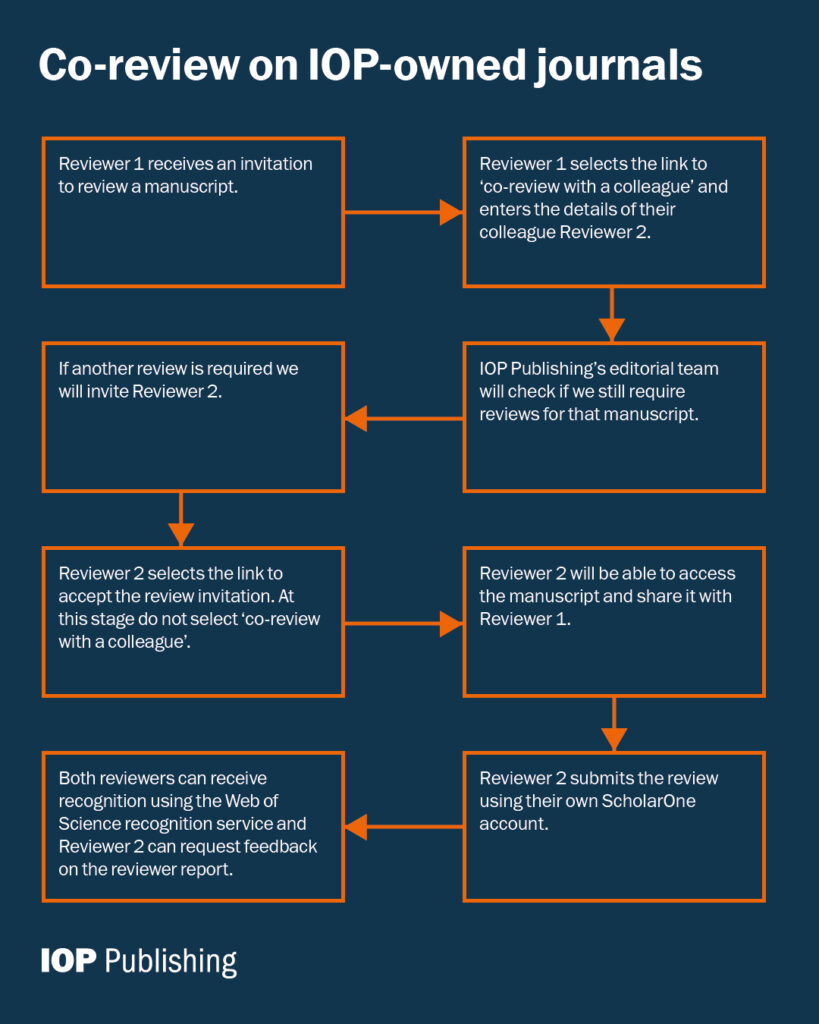
If you are invited to review and wish to co-review with a colleague, select the ‘Co-review with a colleague’ link in the journal’s invitation email. You will be asked for the name and contact details of the person you will be co-reviewing with. Your co-reviewer will be invited to review the manuscript if we still require reviewers. If they accept the invitation you can work on the reviewer report together. The completed reviewer report form should be submitted to the journal through the co-reviewer’s ScholarOne account.
IOP Publishing processes all data in line with its privacy policy.
What to do if you have been invited to co-review by a senior colleague?
Co-review is a great way to get involved in the peer review community. Critiquing a manuscript can give you a deeper knowledge of your field, help you understand how to structure and write your own manuscripts, and build confidence in your own expertise.
While it is your responsibility to write and submit the reviewer report, the colleague that recommended you should help you through this process.
Here are some tips on how to review a manuscript:
If this is your first time reviewing, we strongly advise that you complete our free Peer Review Excellence online training. We recommend this training to early career researchers and anyone who is submitting their first review. This comprehensive training course is designed to give researchers in the physical sciences the tools and confidence to review well. The course covers the fundamentals of peer review, how to write a review and peer review ethics. Our Peer Review Excellence course takes 1–2 hours to complete. You can register for free here: Peer Review Excellence.
What support to provide if you have recommended a colleague to co-review
We ask that senior researchers co-reviewing with more junior colleagues provide support through the peer review process.
Here are some tips for ensuring successful co-review. After deciding to co-review:
Check that your colleague understands what is expected
Help them to set up a timeline to complete the reviewer report by the deadline
Give them time to complete their report
Read over their report before it is submitted and discuss with them any suggestions for changes
Check that their recommendation matches the content of the reviewer report
You may also want to direct your co-review colleague towards formal training in peer review. IOP Publishing offers free, online peer review training, tailored specifically for the physical sciences. The training course takes 1–2 hours to complete and can be accessed here: Peer Review Excellence.
At IOP Publishing, we are aware that early career researchers and PhD students will occasionally write reviewer reports on behalf of their supervisors without receiving any credit for their work. By implementing this co-review functionality on our system we hope to:
Alleviate the burden for senior researchers who receive many invitations to review
Allow early career researchers to build their peer review competency
Provide early career researchers with benefits and rewards for reviewing
Ensure full accountability in peer review, so that everyone who contributes to peer review is known to the editorial team
Co-review FAQs
Can journal board members use the co-review functionality?
Board members should not delegate with co-review. As a board member we rely on your expertise in your field and your knowledge of the journal. Also, there made be problems with confidentiality. Therefore, it is inappropriate for your colleague to work on the report.
I delegated to a colleague, but they have not been invited yet?
There may be a short delay between you letting us know you want to co-review with a colleague and your colleague receiving the invitation to review while our editorial team check if any more reviewer reports are needed on the manuscript. In some cases other reviewers will have accepted their review invitations and additional reports are not required.
How do I view the manuscript if I delegated to a colleague?
The colleague you are reviewing with will receive an invitation and instructions on how to collaborate with you ‘offline’ to complete the reviewer report. Once they have received and accepted the invitation they will be able to access the manuscript and share it with you.
How do I accept the review invitation if a colleague delegated the review to me?
If you have received a review invitation after your colleague recommended you for co-review, you will need to accept the review invitation. Do not select ‘Co-review with a colleague’ as this will prompt you to enter the details of a new colleague.
Can I delegate a review to more than one colleague?
If you would like more than one colleague to work on the reviewer report please contact the journal inbox. We do allow this but it is important that our editorial team know who has written the report. Only one colleague will be able to receive the invitation and submit the reviewer report.
Find clear and practical guidance to support your publishing journey. These resources share insight from experienced and highly cited researchers, helping you develop confidence, improve your writing and make informed decisions about your research career.
This article presents practical advice from highly cited authors based in India and North America. It focuses on actionable recommendations that early‑career researchers can use to strengthen their visibility, improve research communication and understand what successful authors did early in their careers.
This article explains how top‑cited authors structure and communicate their work to achieve greater influence and clarity. Highlighting writing approaches that have helped papers perform better and giving guidance that early‑career researchers can apply directly to their own manuscripts.
Highly cited researchers across North America share clear and actionable advice on how to strengthen the impact of your work. (From left to right: Carl White, Stephen Taylor and Sarah Vigeland)
The article highlights how meaningful impact comes from solving important problems, engaging across disciplines and communicating research in a way that attracts broad readership. Insights from astrophysicists Sarah Vigeland and Stephen Taylor show how long‑term collaboration and relevance to multiple scientific communities can amplify visibility. The article also features bio‑inspired engineer Carl White, whose interdisciplinary work on tuna‑inspired robotics demonstrates how cross‑field innovation can drive citation growth and research influence.
Authors are not responsible for article publication charges (APCs). Article publication charges are agreed directly with Conference Organisers and included in the Publishing Agreement. The cost is calculated on a paper fee basis upon delivery of the content.
Papers are required to be in their final form for publication and post-publication changes will be charged directly to authors.