
Co-review with a colleague on partner titles
What is co-review?
Co-review allows two people to collaborate on a reviewer report, with both having the option to receive recognition via Web of Science. We offer co-review in the hope that early career researchers with limited experience of peer review can work together with more experienced colleagues or supervisors to build their peer review competency.
How to co-review on IOP Publishing journals
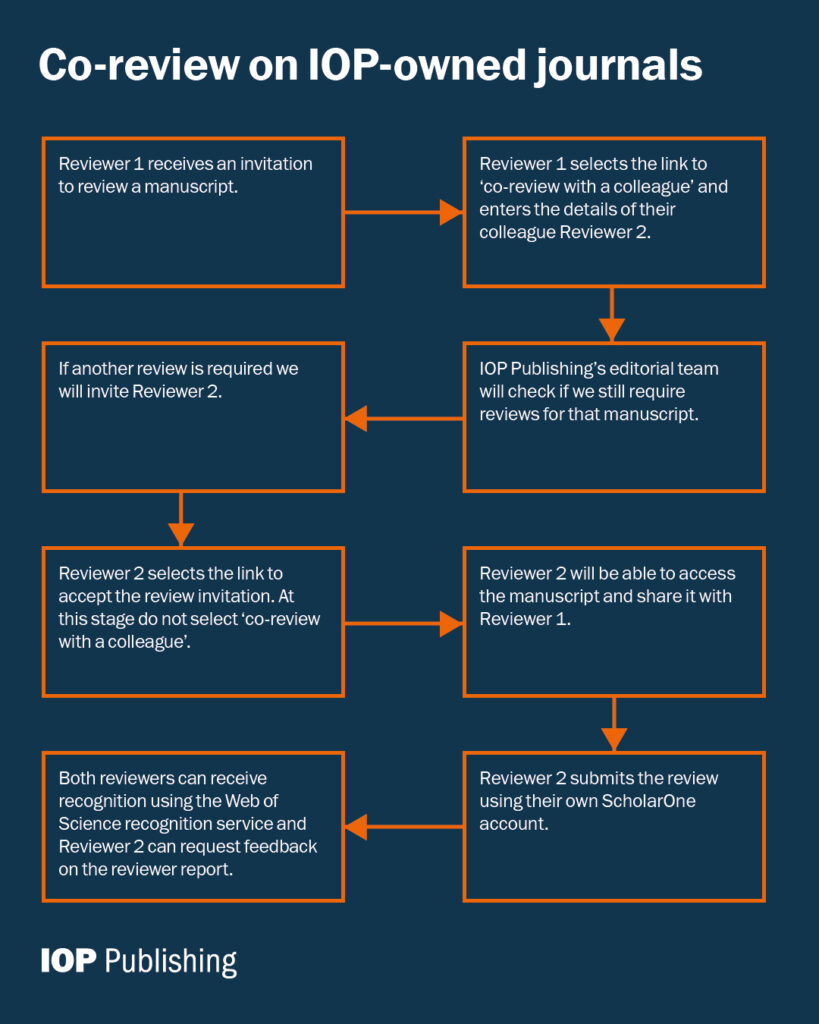
If you are invited to review and wish to co-review with a colleague, select the ‘Co-review with a colleague’ link in the journal’s invitation email. You will be asked for the name and contact details of the person you will be co-reviewing with. Your co-reviewer will be invited to review the manuscript if we still require reviewers. If they accept the invitation you can work on the reviewer report together. The completed reviewer report form should be submitted to the journal through the co-reviewer’s ScholarOne account.
IOP Publishing processes all data in line with its privacy policy.
What to do if you have been invited to co-review by a senior colleague?
Co-review is a great way to get involved in the peer review community. Critiquing a manuscript can give you a deeper knowledge of your field, help you understand how to structure and write your own manuscripts, and build confidence in your own expertise.
While it is your responsibility to write and submit the reviewer report, the colleague that recommended you should help you through this process.
Here are some tips on how to review a manuscript:
- If this is your first time reviewing, we strongly advise that you complete our free Peer Review Excellence online training. We recommend this training to early career researchers and anyone who is submitting their first review. This comprehensive training course is designed to give researchers in the physical sciences the tools and confidence to review well. The course covers the fundamentals of peer review, how to write a review and peer review ethics. Our Peer Review Excellence course takes 1–2 hours to complete. You can register for free here: Peer Review Excellence.
- Follow this link to find information on How to prepare and send in your reviewer report.
- Ensure that you get feedback and support from your co-reviewer by sending them your reviewer report to read before it is submitted.
To find more information on what submitting a reviewer report entails, you can read IOP Publishing’s information on Becoming a journal reviewer, How to prepare and send in your reviewer report, and After you have submitted your reviewer report.
What support to provide if you have recommended a colleague to co-review
We ask that senior researchers co-reviewing with more junior colleagues provide support through the peer review process.
Here are some tips for ensuring successful co-review. After deciding to co-review:
- Check that your colleague understands what is expected
- Help them to set up a timeline to complete the reviewer report by the deadline
- Give them time to complete their report
- Read over their report before it is submitted and discuss with them any suggestions for changes
- Check that their recommendation matches the content of the reviewer report
You may also want to direct your co-review colleague towards formal training in peer review. IOP Publishing offers free, online peer review training, tailored specifically for the physical sciences. The training course takes 1–2 hours to complete and can be accessed here: Peer Review Excellence.
Co-review ethics policy
All reviewers must follow the reviewer guidelines for IOP Publishing journals, including ethics for reviewers, and COPE’s Ethical Guidelines for Peer Reviewers.
Why do we offer co-review on our journals?
At IOP Publishing, we are aware that early career researchers and PhD students will occasionally write reviewer reports on behalf of their supervisors without receiving any credit for their work. By implementing this co-review functionality on our system we hope to:
- Alleviate the burden for senior researchers who receive many invitations to review
- Allow early career researchers to build their peer review competency
- Provide early career researchers with benefits and rewards for reviewing
- Ensure full accountability in peer review, so that everyone who contributes to peer review is known to the editorial team
Co-review FAQs
- Can journal board members use the co-review functionality?
Board members should not delegate with co-review. As a board member we rely on your expertise in your field and your knowledge of the journal. Also, there made be problems with confidentiality. Therefore, it is inappropriate for your colleague to work on the report.
- I delegated to a colleague, but they have not been invited yet?
There may be a short delay between you letting us know you want to co-review with a colleague and your colleague receiving the invitation to review while our editorial team check if any more reviewer reports are needed on the manuscript. In some cases other reviewers will have accepted their review invitations and additional reports are not required.
- How do I view the manuscript if I delegated to a colleague?
The colleague you are reviewing with will receive an invitation and instructions on how to collaborate with you ‘offline’ to complete the reviewer report. Once they have received and accepted the invitation they will be able to access the manuscript and share it with you.
- How do I accept the review invitation if a colleague delegated the review to me?
If you have received a review invitation after your colleague recommended you for co-review, you will need to accept the review invitation. Do not select ‘Co-review with a colleague’ as this will prompt you to enter the details of a new colleague.
- Can I delegate a review to more than one colleague?
If you would like more than one colleague to work on the reviewer report please contact the journal inbox. We do allow this but it is important that our editorial team know who has written the report. Only one colleague will be able to receive the invitation and submit the reviewer report.