
Society Members
What societies does IOPP support?
Supported societies and their access
Institute of Physics and Engineering in Medicine (IPEM)
- Access to all IPEM Journals and Reports, with all content years available.
- IPEM membership page: Click here
The London Mathematical Society (LMS)
- Access to the journal Nonlinearity, with coverage depending on membership type.
- LMS membership page: Click here
The Astronomical Society of the Pacific (ASP)
- Access to Publications of the Astronomical Society of the Pacific (PASP), usually the current year plus the previous ten years.
- ASP membership page: Click here
Japan Society of Fluid Mechanics (JSFM)
- Access to Fluid Dynamics Research (FDR).
- JSFM membership page: Click here
Institute of Physics (IOP)
- Full access to 70 IOP‑owned journals and all available content years — the widest access of any membership.
- IOP membership page: Click here
The Society for Radiological Protection (SRP)
- Access to the Journal of Radiological Protection and the Journal of the Society for Radiological Protection, with all content years available.
- SRP membership page: Click here
The Japan Society of Applied Physics (JSAP)
- Access to the Japanese Journal of Applied Physics and Applied Physics Express, with all content years available.
- JSAP membership page: Click here
The Italian Physical Society (SIF – Società Italiana di Fisica)
- Access to EPL (Europhysics Letters), with all content years available.
- SIF membership page: Click here
Not sure which society you belong to?
As an IPEM member, what content can I access?

Since forming a partnership in 1972, IPEM and IOP Publishing have continued to deliver high-quality resources to the medical physics and biomedical engineering community. Our content is designed for advanced learners, researchers and professionals, offering a wide range of publications in medical physics, biomedical engineering and related fields. It covers subject such as clinical engineering and diagnostic imaging, MRI, nuclear medicine, health informatics and psychological monitoring. It also explores radiation safety, rehabilitation technologies, and other forms of non-ionising radiation.
As an IPEM member, you will have full access to our Physics and Medical Engineering collections:
- Physics in Medicine and Biology
- Physiological Measurement
- Medical Engineering and Physics
- Medical Sensors and Imaging
- Biomedical Physics and Engineering Express
You will also have full access to a comprehensive collection of ebooks specialising in medical Physics and biomedical engineering. To discover more about our ebooks and browse the collection, please head to our IPEM Partner Series page.
If you have any further questions, please contact our Customer Service team.
As an IPEM member, how do I access my content?
How can I access your content:
To access our content, simply visit the IPEM website and select Login. Sign in using your IPEM membership details, and you’ll be able to search for any journals or research materials you need.
If you’re a Full Member or Fellow, you’ll benefit from single sign-on (SSO) – once you choose a title, you’ll be taken straight to the content without needing to log in again.
Accessing on IOPscience:
For Associate and Affiliate Active Members, you will need to login via our IOPscience website and will have uninterrupted access to Physics, Medicine and Biology.
- Head to the IOPscience login page.
- Enter your membership username and password.
If you need any help accessing your subscription, please contact the Customer Service team.
As an LMS member, how do I access my content?
As an LMS member, you can access all your entitled content and our full archive through the IOPscience website.
How to access your LMS content
- Go to the IOPscience sign-in page.
- Enter the email address associated with your LMS membership.
- If you have not used IOPscience before, select Don’t remember your password at the bottom of the login page.
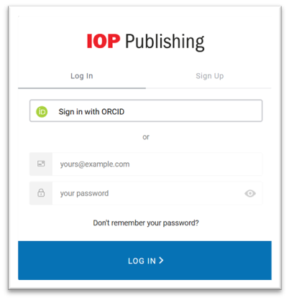
Once you have created your login credentials, you will be presented with a short form to complete your IOPscience user profile. You will only need to complete this on your first visit.
Need help?
If you need help accessing your subscription, please contact the Customer Service team at IOP Publishing.
As an LMS member, what IOPP content can I access?
London Mathematical Society (LMS):
IOP Publishing works in partnership with the LMS to publish high-quality mathematical content, including Nonlinearity – a leading journal dedicated to nonlinear science and jointly owned by LMS and IOP. Through this collaboration, 100% of the proceeds are reinvested back into the physics and mathematics communicates, helping support ongoing research and development.
What can I access as an LMS member?
- Free online access:
- LMS members can read Nonlinearity online at no cost once their membership profile has been activated.
- Submit your research:
- Authors, who have an LMS membership, can also submit their papers directly through our IOPscience website.
- Additional LMS member benefits:
- Research funding opportunities
- Member-only events
- Contribute to important discussions that shape national mathematics policies.

For more information on Nonlinearity, please visit our IOPscience website.
If you have any further questions, please contact our Customer Service team.
As an ASP member, how do I access my content?
As an ASP member, you can access all related content through the IOPscience website.
If you are not yet an ASP member
To join the ASP community, visit the Join the ASP Community! page and follow the sign-up steps. Once you complete the membership application, the ASP team will pass your details to our Customer Service team. They will set up your access to the journal Publications of the Astronomical Society of the Pacific (PASP). You will receive an email with your access instructions.
Accessing PASP on IOPscience
You can find current and archived PASP issues here: https://iopscience.org/pasp
As a technical member of the ASP, you receive uninterrupted access to PASP.
How to sign in:
- Go to the IOPscience login page:
- Enter your username and password.
Once logged in, you will have access to:
- The current year of PASP
- Plus to previous ten years of content
If you need any help accessing your subscription or are unsure which email address is linked to your ASP membership, please contact the Customer Service team.
As an ASP member, what IOPP content can I access?
As an ASP member, you get access to the Publications of the Astronomical Society of the Pacific (PASP) on the IOPscience platform.
What is included with your ASP membership:
- PASP online access
- You can read all PASP content from the current year plus the previous ten years.
- For example: in 2026 you will have access to content from 2016-2026
- Free-to-read and Open Access content
- You can read all PASP content from the current year plus the previous ten years.
if you need any help or information, please contact the Customer Service team.
As an JSFM member, how do I access my content?
As an JSFM member, you can access all related content through the IOPscience website.
If you are not yet a JFSM member
To join JFSM, visit the Join the JSFM page and follow the sign-up steps.
Once you’ve completed the signup process, the JSFM team will pass your details to our Customer Service team. We will then set up your access to the journal Fluid Dynamics Research (FDR). You’ll then receive an email with your access instructions.
Accessing FDR on IOPscience
You can find current and archived FDR issues here
As a member of the JSFM, you’ll have uninterrupted access to FDR content on IOPscience.
How to sign in:
- Go to the IOPscience login page, here
- Enter your username and password.
Once logged in, you’ll be able to view all FDR content years.
If you have any further questions, please contact the Customer Service team.
As an JSFM member, what IOPP content can I access?
As an JSFM member, you get access to the Fluid Dynamics Research (FDR) on the IOPscience platform.
What is included with your JFSM membership
-
-
- Complete FDR archive access
- You can read every volume from 1986-2026 (and new 2027 content as it publishes)
- Free-to-read and Open Access content
- Complete FDR archive access
-
if you need any help or information, please contact the Customer Service team.
As a society member why can I not access my content?
What determines what you can access
Your society membership unlocks a specific set of entitlements. These usually differ in two ways:
- Which journal(s) you can read
- How many years of content are available to you
Because each society negotiates its own arrangement, two members logging in through IOPscience may see very different levels of access even though both are “society members.”
How access typically differs between societies
This is where most confusion comes from. Some societies provide access to one journal, while others include a full archive.
- IPEM members — Access to Physics in Medicine & Biology (PMB)
- Content years: 1956-2027
- LMS members — Access to titles such as Nonlinearity
- Content years: 1988-2027
- ASP members — Access to Publications of the Astronomical Society of the Pacific (PASP),
- Coverage: current year plus the previous ten years.
- JSFM members — Access to Fluid Dynamics Research (FDR)
- Content years: 1986-2027
- IOP Members (full IOP membership) — Access to all IOP owned journals
- Content years: all available content years (which is the broadest access we offer).
If you are expecting access to multiple journals or full archives but your society membership only includes one title or a limited range of years, the system will show restricted access because that reflects the entitlement set by your society.
How to check what you should have
If you’re not sure which society you’re a member of, or what your membership includes, there are a few easy ways to confirm:
- Look at your society’s membership confirmation or welcome email
- Check the membership benefits section on your society’s website
- Review any login details the society provided for IOPscience
And if you’re still unsure, our Customer Services team can look up your membership type and confirm exactly what you should be able to access.